
Microsoft's announcement of Microsoft Frontier Company is one of the clearest signals yet that the AI market is moving from model access to implementation.
CNBC reported that Microsoft is committing $2.5 billion and 6,000 employees to a new AI implementation unit focused on helping businesses adopt AI through embedded engineering and industry expertise. Satya Nadella framed the future of the firm as a learning loop where human capital and token capital compound. Microsoft's own announcement describes Frontier Company as a mix of enterprise AI engineering, deep industry knowledge, change management, continuous improvement, protected customer intelligence, and measurable business outcomes.
That is a lot of language, but the plain-English version is simple: businesses do not need another AI demo. They need help turning AI into something their people can trust and use.
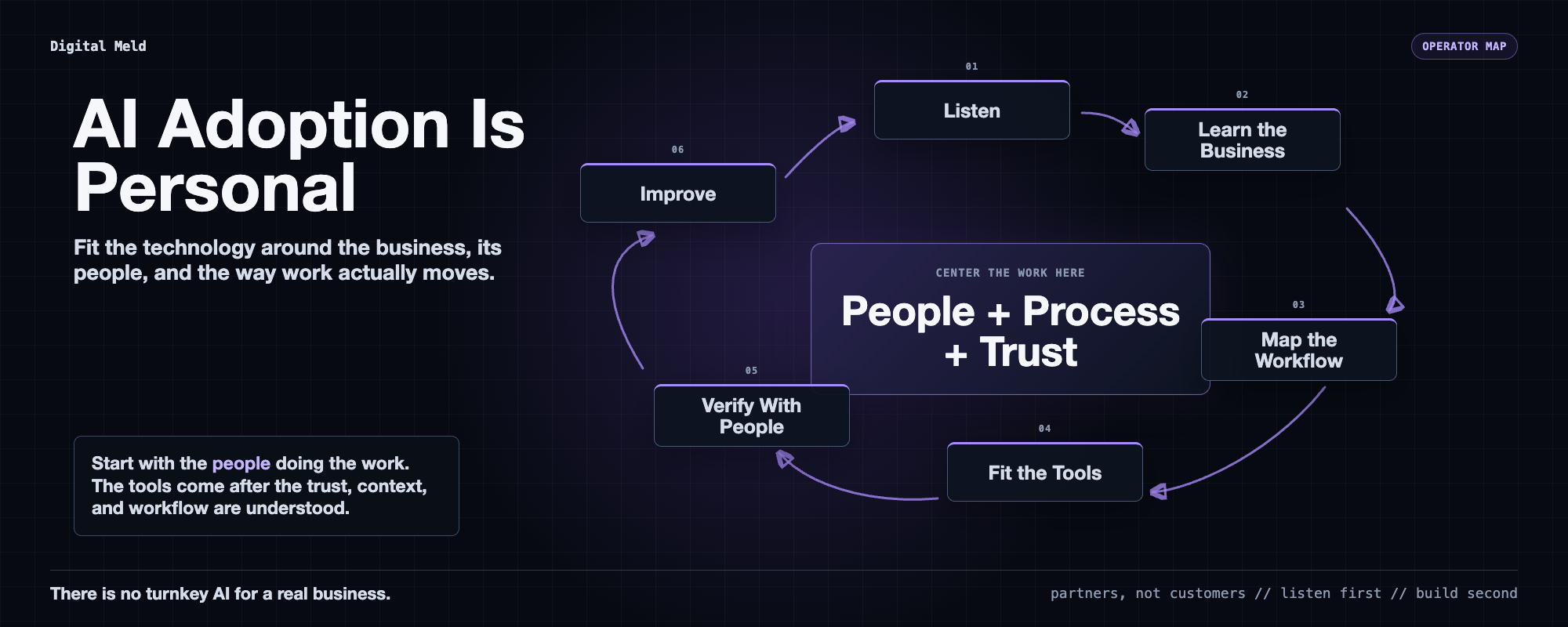
For nearly four years, Digital Meld has worked from that same operating belief. AI adoption is not a turnkey product. It is a partner journey.
The Model Is Not the Whole Answer
The last few years of AI have made one thing obvious: model access is not the same as business adoption.
A company can buy licenses, enable a copilot, connect a few data sources, run a pilot, and still end up with very little changed in the day-to-day work. That does not mean the AI was useless. It usually means the AI was never fitted to the business.
Real companies are full of context that does not live cleanly in one system. The source of truth may be split across an ERP, a spreadsheet, a SharePoint folder, a Teams chat, a finance export, a field form, a whiteboard photo, and one person who knows why the official workflow stopped matching reality two years ago.
That is not a technology problem first. It is a trust and workflow problem.
AI can help, but it needs the right operating model around it. It needs clean enough data, understood workflows, security boundaries, human approval points, support ownership, and feedback loops. Most of all, it needs people who are willing to learn the business before changing it.
Why Digital Meld Says Partners, Not Customers
Digital Meld does not treat the companies it works with as passive customers.
Digital Meld calls them partners because the work is collaborative. A customer buys something from a company. A partner builds something with a company.
That distinction matters when AI enters the room.
If the posture is "we have a solution, now fit into it," the work usually fails quietly. People nod in the meeting, try the new tool for a few weeks, then drift back to the spreadsheet, email thread, or manual handoff that still feels safer.
If the posture is "we are going to learn how your business actually works," the conversation changes. People explain the exceptions. They show the workaround they were embarrassed to mention. They tell you which report nobody trusts. They explain why the field team does not open the system until the end of the day. They show where the process breaks when finance, operations, safety, project management, and leadership all touch the same job.
That is where useful AI starts. Not with the model. With empathy and context.
The Real Work Is Messier Than the Demo
In partner work, the first request is often framed as a technology request.
"We need AI."
"We need automation."
"We need a dashboard."
"We need an app."
Those requests are valid, but they are rarely the full problem. A company may ask for AI and discover the first useful step is fixing intake. A team may ask for reporting and discover the real issue is that departments use different definitions of the same status. A manager may ask for an agent and discover the best employee's judgment has never been written down anywhere. A business may ask for automation and discover the process depends on a spreadsheet everyone complains about but everyone still trusts.
That is normal. Businesses are human systems. They have history. They have habits. They have constraints. They have people doing quiet work to keep things moving.
AI adoption has to respect that reality.
- A model can summarize a process document. It cannot know whether the process document is fiction.
- A model can generate a dashboard. It cannot fix trust in the numbers underneath it.
- A model can draft a workflow. It cannot know whether the people who need to use it were included in the design.
- A model can write code. It cannot decide who should support the system after launch.
Those are business decisions. They require partnership.
What Microsoft's Move Signals
Microsoft is not alone in this shift. OpenAI, Anthropic, Amazon, and major consulting firms are all putting more energy into hands-on AI implementation.
That should tell every business leader something important: the hard part is not simply choosing the best model.
The hard part is applying AI to the specific way a business creates value.
Microsoft's announcement says companies need an intelligence platform where proprietary data, expertise, workflows, and decision-making compound over time. It also points to trust, observability, governance, security, model flexibility, cost controls, and continuous improvement.
That is much closer to the reality Digital Meld sees with partners every day.
AI adoption works when it becomes part of the operating system of the business. Not the software operating system. The human one: how work is requested, approved, completed, measured, corrected, and improved.
What Businesses Should Do First
For leaders trying to move past AI pilots, the best next step is usually smaller and more practical than expected.
Start with one workflow that hurts enough to matter.
Then ask:
- Who owns this workflow today?
- Who actually does the work?
- Where does the data come from?
- Which system is trusted, and which system is ignored?
- What decisions are people making manually?
- What should AI be allowed to recommend?
- What should AI never do without approval?
- Who has to support the workflow after launch?
- How will the team know whether the change helped?
Those questions will do more for AI adoption than another broad strategy deck.
Once the workflow is understood, the tool choices become easier. The answer might be Microsoft 365, Power Platform, Dataverse, a custom app, a dashboard, an automation, an agent, OpenClaw, Codex, or a simple integration that never makes a headline but saves hours every week.
The tool is not the point. The fit is the point.
The Digital Meld View
Digital Meld helps partners fit AI, automation, software, and Microsoft cloud workflows around the way their businesses actually operate.
That means learning the business before prescribing the system. It means treating people as part of the design, not as an adoption problem to solve later. It means protecting data and trust boundaries. It means creating source-of-truth workflows. It means building feedback loops so the system improves instead of fossilizing a bad process.
It also means being honest about what AI cannot shortcut.
- AI cannot skip trust.
- AI cannot skip process ownership.
- AI cannot skip change management.
- AI cannot skip listening to the people who know the work.
There is no turnkey solution for that. There never was.
The companies that win with AI will not be the ones that simply buy the most licenses or chase every new model. They will be the ones that learn their own business deeply enough to use AI with judgment.
Start small, think big, and fit the technology around the people.
That is where the real value is.
Related personal commentary from Brad Groux: Twitter article and LinkedIn post.