
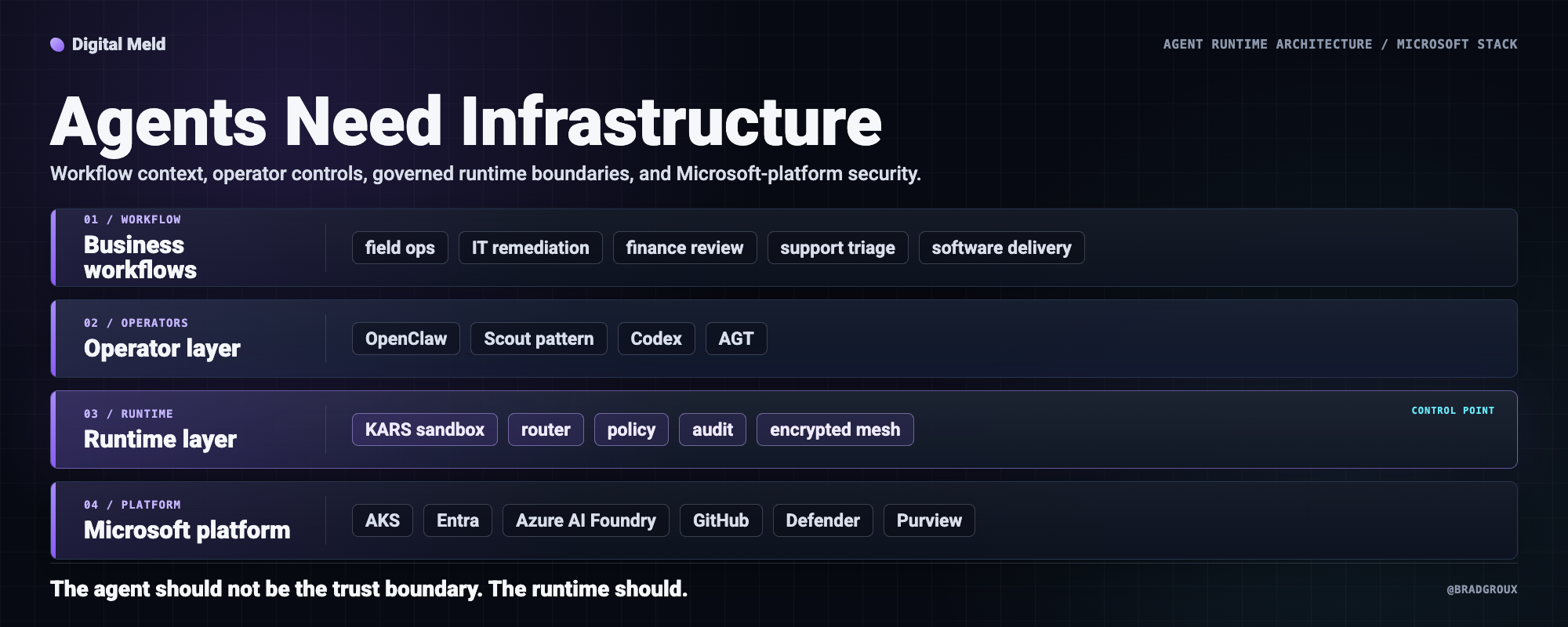
Microsoft's KARS announcement is easy to file under "interesting open-source AI repo" and move on. That would miss the useful part.
KARS stands for Agent Reference Stack for Kubernetes. The name is technical, but the business problem is not. Digital Meld had an early look at KARS while it was being built, and the public release lines up with the direction Microsoft is taking around self-hosted agents, Microsoft Scout, OpenClaw, Microsoft Foundry, and the Agent Governance Toolkit.
If agents are going to act on real business systems, they need a runtime that can answer the same questions IT, security, and operations teams already ask about normal software:
- What identity is this workload using?
- What secrets can it see?
- What network paths are allowed?
- What systems can it call?
- What gets logged?
- What requires approval?
- What happens when it is wrong?
- What happens when it is compromised?
Those questions are not blockers. They are how useful software gets trusted. KARS matters because it treats agents as production workloads instead of clever prompts.
The Agent Is Not the Trust Boundary
Most agent demos focus on the visible action: a tool call, a code change, a ticket, a summary, a file, a calendar update, or a workflow step. The harder part is deciding what the agent should be allowed to do before that action happens.
The KARS repo frames the problem directly: useful agents need real tools, and real tools create real access risk. In a business setting, that creates too much blast radius if the agent process becomes the boundary.
The agent runs in a hardened sandbox. In production, the agent and inference router run as separate containers with different UIDs. The agent does not hold the Azure credential. The agent does not get direct network egress. Every outbound call goes through the router, with Kubernetes NetworkPolicy and the egress guard acting as safety nets.
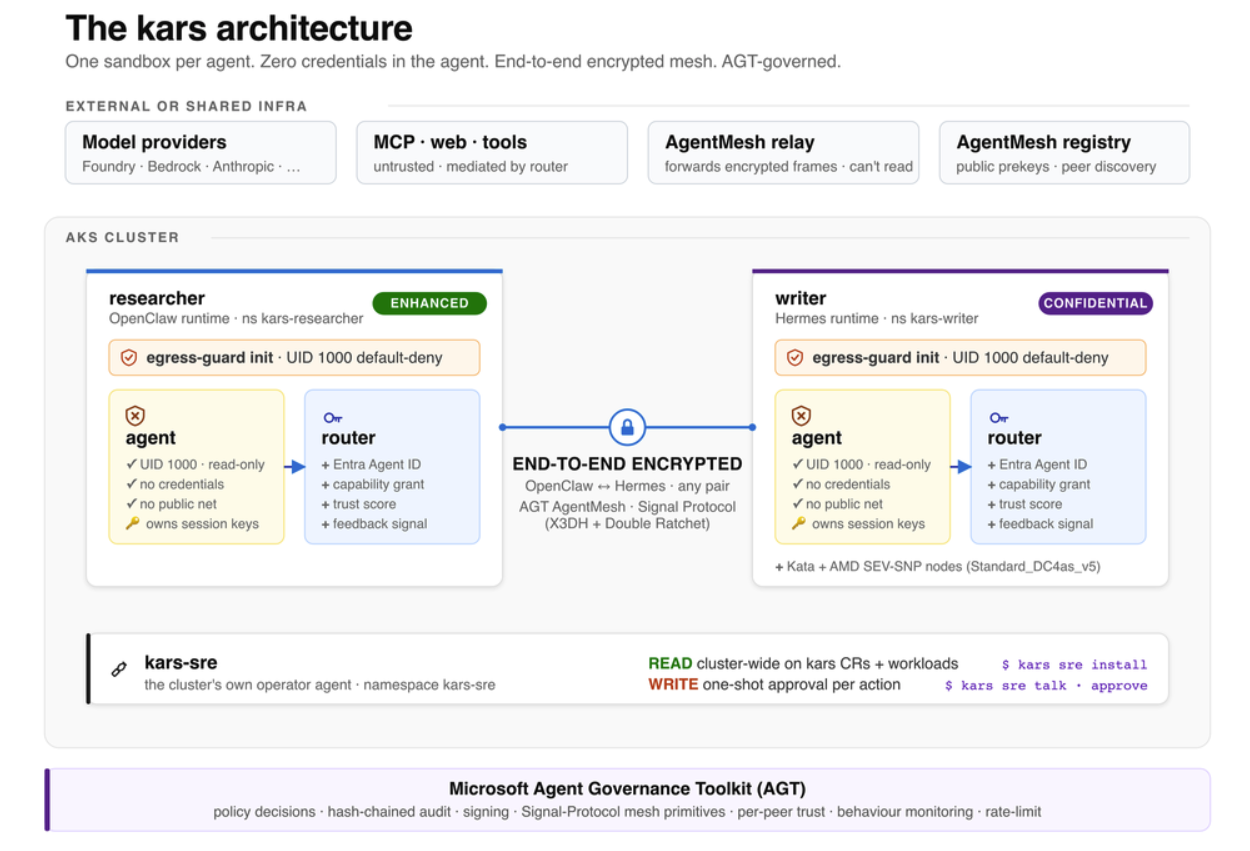
That router becomes the enforcement point for the work:
- identity and token brokering
- Microsoft Foundry and Azure OpenAI calls
- Foundry content-safety signals
- token budgets and rate limits
- tool policy and governance
- egress allowlists and blocklists
- MCP gateway calls
- A2A traffic
- encrypted agent mesh bridging
- tamper-evident audit
- sub-agent spawn and handoff
In plain English, KARS makes the runtime responsible for trust instead of asking the agent to behave perfectly.
Why Kubernetes Matters Here
Kubernetes is not magic, and it is not automatically the right answer for every business app. For agents that need long-running execution, scoped identities, network policy, workload isolation, audit, GitOps, and repeatable deployment, though, Kubernetes is already familiar territory for many Microsoft platform teams. That is why KARS is interesting on AKS.
It uses normal operational concepts: CRDs, Helm, RBAC, NetworkPolicy, service accounts, Workload Identity, and dashboarding through Headlamp. The architecture docs are explicit that the local Kubernetes mode uses kind to reproduce the production pod shape, UID separation, NetworkPolicy, and egress guard before a team goes to AKS.
That reduces a common agent problem where the demo shape and the production shape are different enough that the demo proves very little.
With KARS, the development path can be:
- iterate quickly in local dev
- validate the production-shaped local Kubernetes deployment
- move to AKS with the same mental model
Boring is good here. It means the deployment model has a chance to survive contact with production.
Where OpenClaw, Scout, Codex, and Foundry Fit
KARS becomes more interesting when it is treated as part of the broader Microsoft agent stack instead of a standalone runtime.
OpenClaw can provide the builder/operator surface and runtime adapter. The KARS repo includes an OpenClaw plugin, and the architecture docs describe OpenClaw and Hermes runtime adapters with governance-aware tools and encrypted mesh support.
Microsoft Foundry provides model access, safety signals, and evaluation surfaces. KARS is Foundry-aware and can make Foundry calls through the router rather than exposing credentials directly to the agent. Microsoft's migration docs describe the naming evolution from Azure AI Studio to Azure AI Foundry to Microsoft Foundry, which is why Digital Meld uses the current Microsoft Foundry name here.
Codex can turn engineering work into reviewable artifacts: issues, branches, diffs, tests, PRs, and deployment notes. That matters because agent-written code is only useful when the work stays tied to source control, checks, and human review.
Microsoft Scout points toward the always-on assistant pattern. The more an assistant runs close to daily work, the more important scoped identity, policy, egress, audit, memory boundaries, and approval become.
The Agent Governance Toolkit is the other important piece. It gives teams a shared language for policy enforcement, identity, audit, compliance, SRE controls, mesh trust, and framework integration. KARS can consume those primitives instead of treating governance as one-off agent glue.
KARS is not the whole stack. It is the runtime discipline that makes the rest of the stack easier to trust.
Business Use Cases
Field Operations
A field operations agent could read job context, summarize site notes, check missing forms, draft a daily update, and create a follow-up task. That sounds simple until the agent needs access to project records, safety notes, schedule data, customer information, Teams context, and maybe a work management system.
KARS gives that agent a sandbox, scoped identity, approved tools, governed egress, and an audit path. The agent can help with the workflow without becoming a general-purpose network path.
IT and SRE Remediation
An IT or SRE agent can triage alerts, compare logs, summarize likely causes, and recommend remediation. The dangerous version lets the agent act directly with broad cluster or cloud privileges. The useful version separates diagnosis from approval.
KARS supports a model where proposed operations can be represented as resources with rationale, approval state, TTL, and scoped execution. That gives operations teams agent assistance without hiding change control.
Finance and Procurement
Finance workflows are full of useful agent opportunities: invoice exceptions, purchase requests, vendor comparisons, budget checks, contract summaries, and approval prep. They are also full of sensitive data and separation-of-duty requirements.
For this kind of work, the important question is not whether the model can summarize an invoice. It can. The important question is whether the agent can only see the right systems, use the right tools, stay inside the right workflow, and leave a reviewable trail.
Customer Support and Account Work
Support and account teams can use agents to summarize customer history, search product docs, draft responses, prepare meeting notes, and create follow-ups. The guardrail is account boundary discipline. The agent should not wander across tenants, customers, inboxes, or systems just because the prompt asked nicely.
KARS puts that control closer to the runtime.
Software Delivery
Software delivery is where OpenClaw, Codex, GitHub, and KARS can work together well. Codex can handle scoped repo work. OpenClaw can coordinate longer-running context and tools. GitHub keeps the work reviewable. KARS can run the agent side with policy, identity, egress, and audit.
The value is not "AI wrote code." The value is that the work is scoped, reviewed, tested, and traceable.
The Caveat
KARS is not an officially supported Microsoft product. The repo is clear that it is an open-source reference implementation from the Azure Cloud Native team with no SLA, support contract, or product roadmap commitment.
Digital Meld would not recommend treating KARS like a drop-in production platform without review. The right approach is to evaluate it against a narrow workflow, validate the security model, test the local Kubernetes path, inspect the CRDs, prove the audit trail, and decide which parts fit the business. That caveat does not make KARS less important. It makes it more honest.
What Businesses Should Do Next
For Microsoft-focused teams exploring agents, KARS is worth studying even if they do not deploy it immediately. Start with one workflow where an agent would be useful but risky:
- it touches sensitive data
- it needs tools
- it has a real approval boundary
- it requires audit
- it could cause damage if compromised
Then map the runtime questions:
- What identity does the agent need?
- What tools should it use?
- What network egress should be allowed?
- What should be denied?
- What budget or rate limit should apply?
- What content-safety rules matter?
- What should be logged?
- What should require approval?
- Who supports the workflow after launch?
Only after that should the team pick the model, the agent runtime, and the deployment shape. KARS gives teams a reference point for the operational side of agents, not just the prompt side.
Agents are becoming long-running, tool-using, network-reaching, data-touching applications. If they are applications, they need application infrastructure.
KARS brings that conversation back to familiar ground for Microsoft shops: AKS, Entra, Microsoft Foundry, GitHub, policies, logs, approvals, and runbooks. That is a better starting point than "the demo worked."
Related personal commentary from Brad Groux: Twitter article and LinkedIn post.