
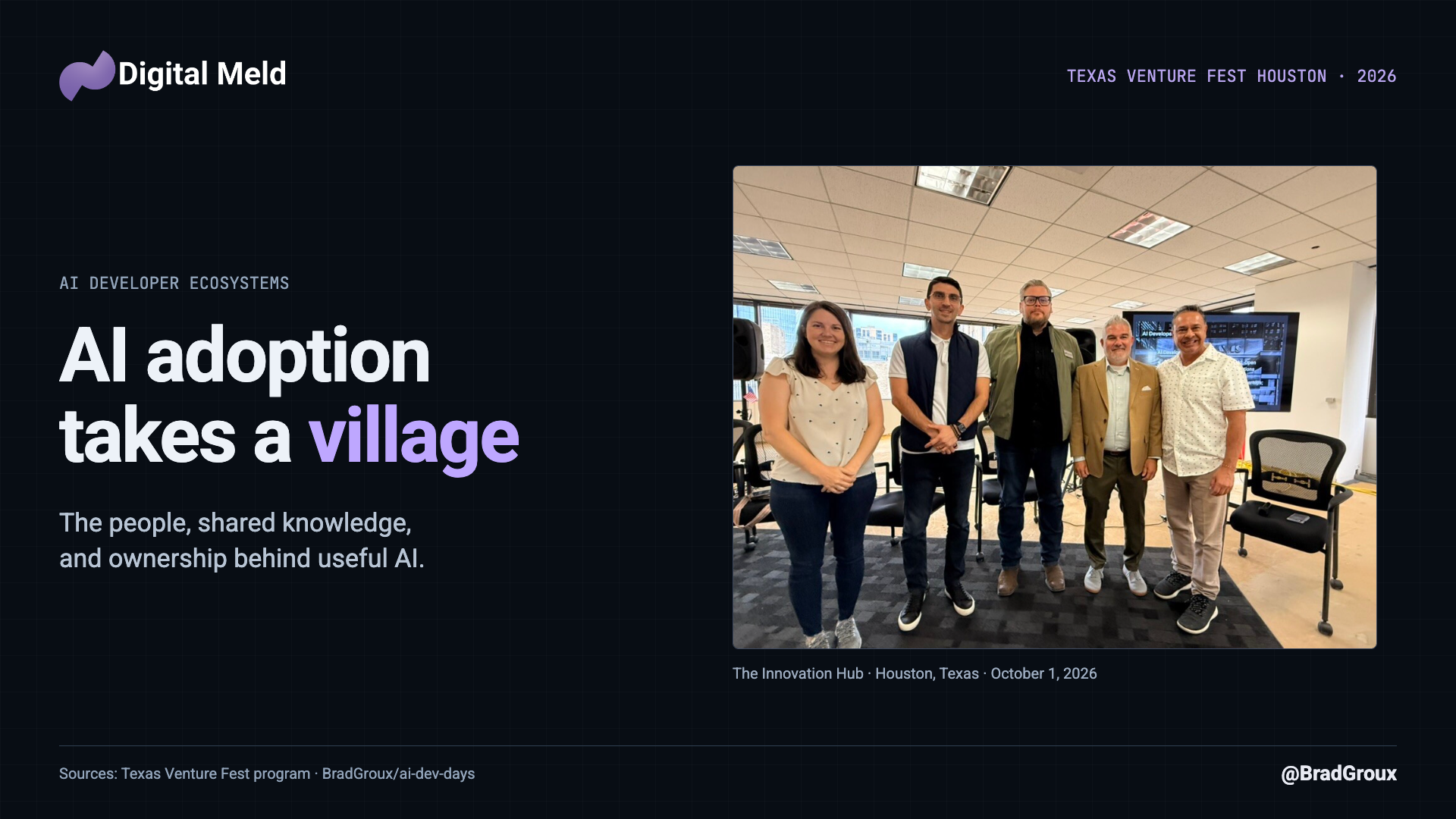
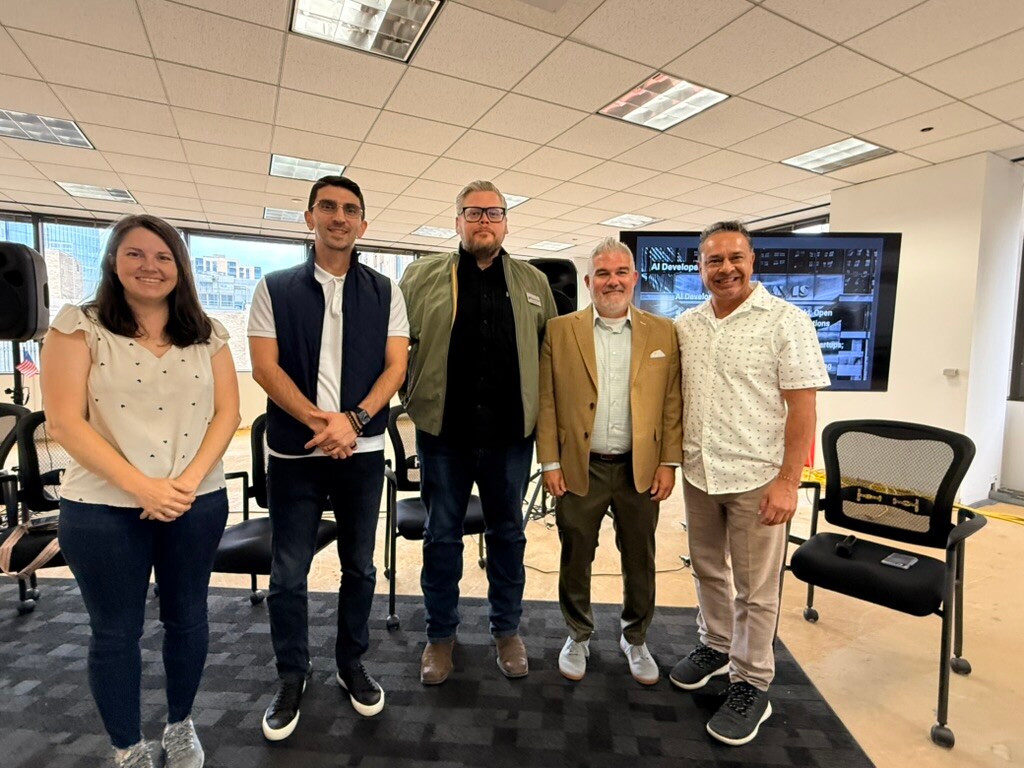
On October 1, 2026, Digital Meld co-founder Brad Groux joined Adrianne Stone and Tony Mamedbekov for the AI Developer Ecosystems panel at Texas Venture Fest: The AI Edition in Houston. The event took place at The Innovation Hub at 801 Travis. Its program covered the state of AI, developer ecosystems, investment, finance, energy, governance, and cybersecurity.
Stone is the founder of Bayou City Startups and a Lovable Houston Ambassador. Mamedbekov is Director of Engineering at SYNERO Consulting and founder of Info Dump. The panel brought together people working on the technology and the communities where builders learn to use it.
AI adoption takes a village. Inside a business, that means bringing the people who know the work into the same process as the people building, governing, and supporting the system.
Start with the people who know the work
Our AI Dev Days materials start with a practical problem: a documented process and the process people actually follow are often different. Workflow owners and domain experts know the exceptions, workarounds, and handoffs that a process diagram can leave out.
Before choosing a tool, ask the team where work gets stuck. Which information do they trust? What do they check before making a decision? When does the usual process stop working? Who gets called when something goes wrong?
Those answers become requirements. They also give people a meaningful role in shaping the change. A workflow owner who helps design and test an AI-assisted process can explain its value, challenge its mistakes, and help colleagues use it responsibly.
Give the village a working structure
Our Rubber Duck Thursday materials describe communication as infrastructure. That is a useful way to think about an AI working group, whatever name the organization gives it.
Bring together an executive sponsor who can resolve priorities, the people who own and perform the workflow, and the domain experts who understand its exceptions. Include data, IT, and security early enough to shape access and support. Give builders and internal champions a clear way to test ideas and bring feedback back to the group.
Then establish a simple rhythm: listen to the problem, agree on a decision, record it, review the result, and improve the next attempt. Keep it small enough to work. Each meeting should resolve something that helps the team move forward.
Make the knowledge reusable
One principle in the Texas Venture Fest slide deck is to own the method while renting the tool. The business needs to retain its process, data, and judgment as technology changes.
That means capturing more than a successful prompt. Write down the purpose of the workflow, its owner, the authoritative sources, the important exceptions, and the conditions for accepting the result. Keep track of why a decision was made so the next person can understand it.
This is how an individual experiment becomes a team capability. A colleague should be able to pick up the work without reconstructing a month of conversations. When a tool changes, the organization should still know what good work looks like.
Build trust into the workflow
People need to understand what the system can do and where their responsibility begins. An AI assistant might gather evidence, prepare a draft, or flag an exception. The team still needs to decide who approves the consequential action.
Make those boundaries visible before the pilot starts. Identify permitted data, required checks, the reviewer, and the conditions that require the system to stop or ask a question. Use repeatable checks for things such as required fields, totals, and thresholds.
Reviewable work gives people something concrete to trust. It also gives skeptics a useful role: finding the cases where the proposed workflow fails. Their questions can make the implementation stronger before the failure reaches a customer.
Prove one useful outcome
The AI Dev Days approach emphasizes a first useful success. Choose a recurring problem with an owner, a clear boundary, and a result the team can inspect.
For example, a team could begin with preparing an exception brief for human review. Measure how long that preparation takes today, where errors occur, and what the reviewer needs. Test the AI-assisted version against the same expectations, including the time spent checking and correcting it.
If the assisted process meets the agreed checks, record the method and let another person try it. If it does not, keep the evidence and adjust the workflow. Either way, the team should leave the pilot knowing more than it did at the start.
Keep the community involved
A local ecosystem extends that learning beyond one company. A founder can compare an adoption problem with a practitioner. A developer can hear where a workflow breaks. A community organizer can introduce people who would otherwise keep solving the same problem separately.
That is a reason to keep showing up, sharing reusable lessons, and helping others get their first useful result. The value of a gathering grows when the introductions lead to continued work.
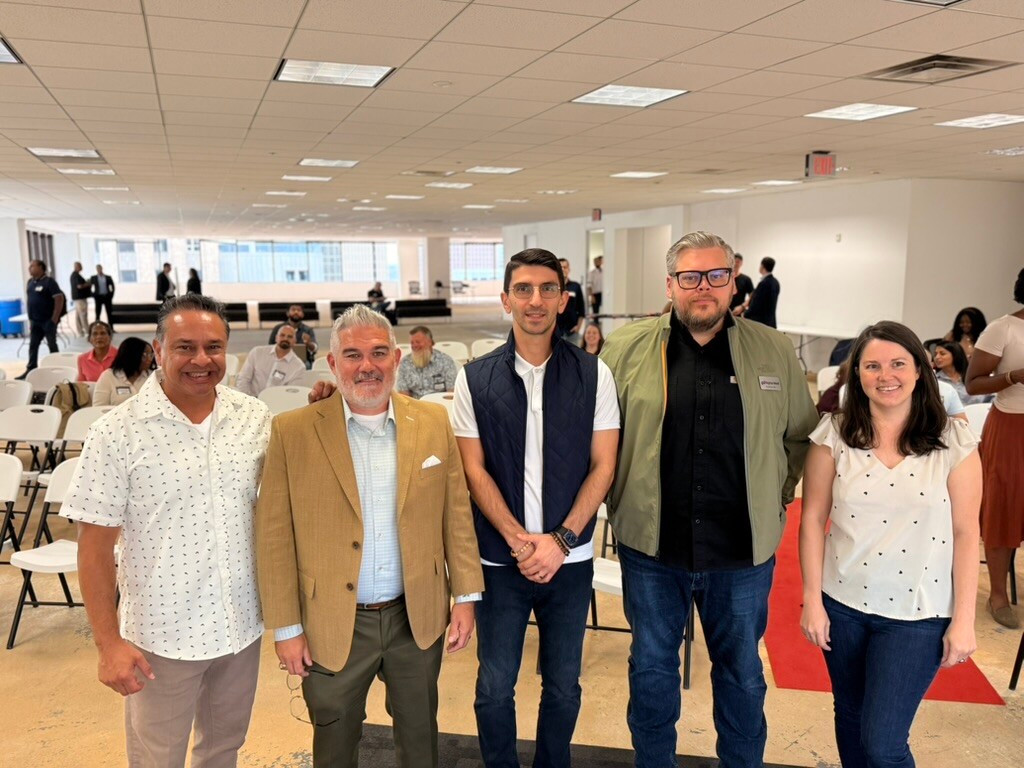
Thank you to Texas Venture Fest Houston host Jesse Martinez, the local organizing team, and the statewide Texas Venture Fest community led by CS Freeland. The next step for teams exploring AI is to choose a workflow, involve its owners, and keep a record of what they learn together.
If your team is deciding where to start, Digital Meld can help map one useful workflow, the people it needs, and the evidence that will show whether it works.