

On April 30, 2026, the World Affairs Council of Greater Houston put a hard question to an audience at Rice University: should democratic nations prioritize artificial intelligence capabilities over AI safety to maintain a strategic advantage?
The Oxford-style format forced a choice that ordinary policy conversations often avoid. Brad Groux of Digital Meld and Texas Representative Giovanni Capriglione argued for the resolution. George Ploss and Mario Rodriguez argued against it. The objective was not to produce a comfortable consensus. It was to make each side defend its priorities and let the audience measure which argument moved them.
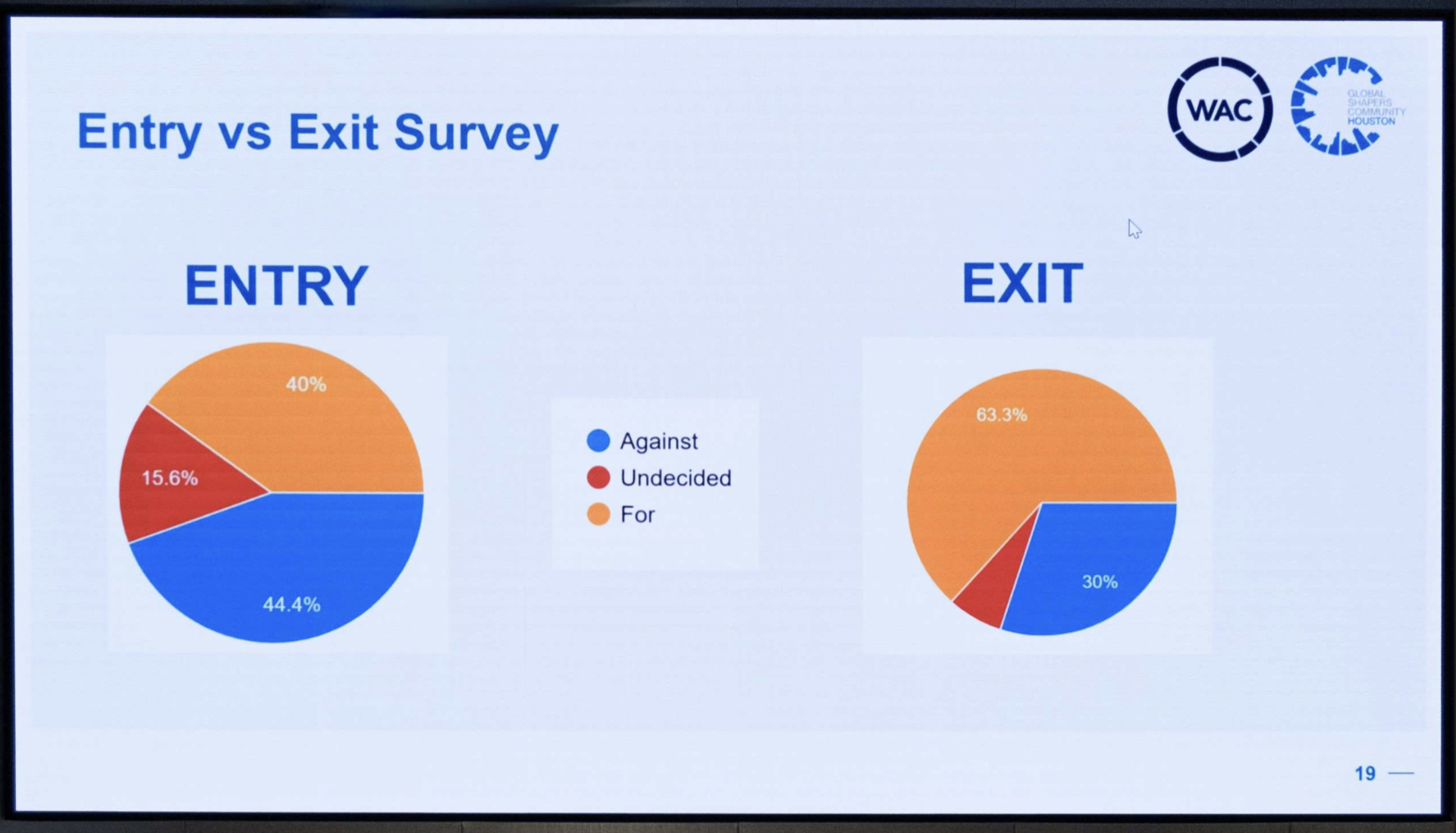
The entry poll started with 40.0% for the resolution, 44.4% against, and 15.6% undecided. The exit poll finished at 63.3% for and 30.0% against, with the remaining 6.7% undecided. Support for the affirmative position increased by 23.3 percentage points among respondents.
Capability makes safety enforceable
Our central argument was straightforward: safety rules only matter if the institutions writing them retain the capability to understand, shape, and enforce them.
A democratic country that steps back from advanced AI development does not stop the technology from advancing elsewhere. It gives up technical leverage, talent, infrastructure, and influence while remaining exposed to the consequences. You cannot audit systems you cannot evaluate, set credible standards without technical depth, or defend critical infrastructure with tools a strategic competitor understands better than you do.
That is not an argument for speed without controls. It is an argument that capability and safety are not independent tracks. Durable safety depends on competent public institutions, technically capable companies, and a workforce that knows how these systems behave outside a product demo.
Democracy is an operating system for accountability
Democratic guardrails are imperfect. Laws arrive late. Regulators can lack resources. Elections, courts, journalism, public pressure, and legislative oversight all have failure modes. But they are mechanisms people can inspect, challenge, and change.
That distinction matters. The safest plausible AI future is not one where democratic nations abandon the field and hope less accountable governments adopt stronger constraints. It is one where democracies lead technically while subjecting that capability to public rules: clear liability, procurement standards, independent testing, incident reporting, due process, and meaningful consequences when organizations cross a line.
The difficult work is keeping capability connected to those controls. Leadership without accountability creates concentrated risk. Accountability without capability creates rules that cannot keep up with the systems they govern.
AI is bigger than chatbots
Much of the public argument about AI is compressed into large language models. That misses the broader capability question. AI systems already touch medicine, cybersecurity, wildfire detection, transportation, logistics, scientific discovery, and the infrastructure governments use to serve the public.
The policy stakes therefore extend beyond whether a chatbot produces a bad answer. They include who can detect a cyberattack, find a new drug candidate, optimize an electrical grid, identify a military threat, or verify that a high-impact automated decision can be explained and appealed.
Treating all of that as one generic risk category produces weak policy. The controls should follow the consequence: stricter evidence and review for systems that can deny liberty, medical care, employment, credit, or essential services; proportionate requirements for lower-risk uses; and room to test before regulation freezes around assumptions that the technology has already outgrown.
The worker and infrastructure questions are real
The sharpest audience questions were not abstract. They dealt with jobs, energy, water, data centers, and whether ordinary people will share in the benefits of systems built around them.
Those concerns deserve operational answers. Slowing domestic development does not stop global adoption or protect a role whose tasks can already be automated. A more useful response is to widen access to the tools, invest in practical training, measure which tasks are changing, and give workers a real path to move into the new workflow.
The same standard applies to infrastructure. A data center is not automatically a public good because it supports AI. Communities should be able to see the resource demands, incentives, jobs, environmental tradeoffs, and enforcement terms attached to a project. Democratic leadership has to earn legitimacy locally, not just compete strategically.


What the result tells us
The 23.3-point movement toward the resolution does not settle the policy question, and an event poll should not be generalized beyond the people who answered it. It does show that the capability case can survive direct scrutiny when safety is treated as part of democratic leadership rather than its opposite.
Our position remains that democratic nations need both: enough capability to shape the technology and strong enough institutions to constrain how it is used. The word “prioritize” made the debate uncomfortable. That was the point. When strategic capability is a prerequisite for enforcing the rules, refusing to build does not create safety. It transfers leverage.
Thanks to the World Affairs Council of Greater Houston, Global Shapers Community Houston, the audience, and all four debaters for a serious discussion.