
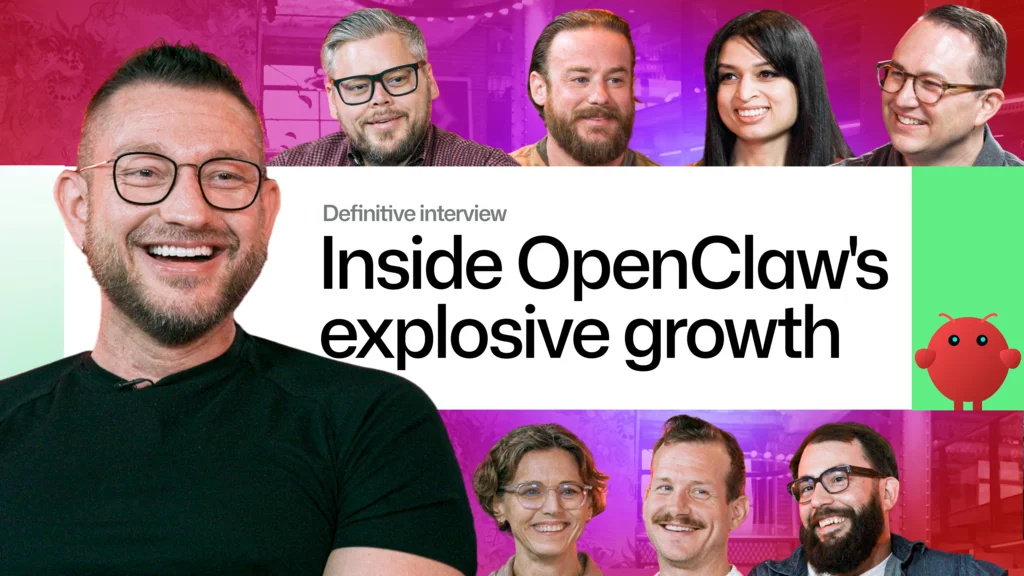
GitHub has released the OpenClaw maintainer conversation recorded during Microsoft Build 2026. The accompanying GitHub feature was written by Gregg Cochran. Brad Groux joined OpenClaw creator Peter Steinberger and fellow maintainers to talk about the work behind a project that moved from a personal experiment to the fastest-growing project in GitHub history.
Start with GitHub's official maintainer story, then watch the full interview on GitHub's YouTube channel. For the wider story from the week, read Digital Meld at Microsoft Build 2026 with OpenClaw, GitHub, and Microsoft.
Six Months of Growth Changed the Maintainer Job
GitHub's feature puts the scale in concrete terms. Peter started OpenClaw as a weekend project in November 2025. By August 26, 2026, the repository had reached approximately 388,000 stars, 81,000 forks, and more than 80,000 commits.
The 46-minute conversation brings together Peter and Brad with Josh Avant, Josh Lehman, Sally O'Malley, Val Alexander, and Vincent Koc. They cover the project's origin, contributor growth, model neutrality, everyday workflows, software supply chain risk, secure defaults, and the GitHub Secure Open Source Fund.
The numbers are remarkable, but the maintainer lessons are more useful. A contribution queue can grow faster than the human systems used to review, secure, and sustain it.
Pull Requests Became an Evidence Problem
OpenClaw's maintainers were not simply reviewing more code. They were handling contributors who could use agents to open hundreds of pull requests, duplicate existing work, or generate changes without understanding how a feature affected the rest of the project.
The response was not to reject AI-assisted contributions. It was to look for better trust signals: agent transcripts, screenshots, test results, and an explanation of the contributor's reasoning. The authorship question matters less than whether someone understands the change and can show that it works.
That standard applies well beyond OpenClaw. As code gets cheaper to generate, proof becomes more valuable. A useful contribution should make the reviewer's job easier, not transfer all verification work to the maintainer.
Maintainers Earn Trust by Finding Where They Can Help
The interview also shows that there was no single path into the maintainer team. People arrived through security work, integrations, community support, and repeated ownership of specific problems.
I’m a Microsoft guy, so I thought, is there a plugin for Microsoft Teams?
Brad Groux
For Brad, the entry point was practical: inspect the Microsoft Teams gap, contribute where his experience fit, and keep taking responsibility. That is a durable open source lesson. Start with a real user need, show the work, and become reliable in a part of the project that needs an owner.
Security Includes Code, Defaults, Dependencies, and Reputation
OpenClaw sits close to personal workflows, developer tools, messaging systems, and business context. That makes security part of the product and contribution process, not a checklist added after adoption.
GitHub's recap surfaces several connected risks. Contribution history can be manipulated as a social trust signal. A default that feels safe to one user can feel restrictive to another. Dependencies bring both technical and maintainer risk. Rapid contribution volume can hide duplicate or promotional changes inside legitimate activity.
The maintainers responded by reconsidering how they assess contributors, reducing core dependencies, and building relationships with upstream maintainers. The important operating point is that security scales through policy, relationships, review evidence, and defaults as much as through code.
The Secure Open Source Fund Added a Global View
OpenClaw participated in Session 4 of the GitHub Secure Open Source Fund. As a graduate of the program through OpenClaw, Brad gained unique insight into security at a global scale: how maintainers responsible for widely used open source projects approach software supply chain risk, dependency trust, secure defaults, disclosure, and response under pressure.
That perspective now informs Brad's security work in OpenClaw and at Digital Meld. The value was not a single checklist. It was direct access to security experts, practical guidance, and relationships with maintainers facing similar problems across different projects, ecosystems, and operating environments.
The fund helped connect repository-level decisions to the larger open source system. A dependency choice, trust signal, or default permission can travel far beyond one project. Seeing those patterns across globally used software gives Brad a broader basis for judging risk and helping organizations build safer systems.
More Output Still Requires Human Boundaries
Agents can give maintainers and contributors time back. They can also make it tempting to keep every queue running and never stop. The conversation treats that tension honestly: the same leverage that shortens a week of work can also erase the natural stopping points that keep a project and its people healthy.
Sustainable open source needs room for first-time contributors, clear evidence standards, security discipline, and maintainers who can step away without the project falling apart.
From Microsoft Build to the Released Interview
The recording was one part of a larger Microsoft Build week that included OpenClaw's booth in the Open Source Zone, GitHub speaking sessions, maintainer time together, and an OpenClaw after-hours event hosted at GitHub. The earlier Digital Meld recap documents that week with photos and context from the sessions.
Read OpenClaw went viral: Meet the maintainers building and securing it on the GitHub Blog, then watch the full conversation on YouTube.