
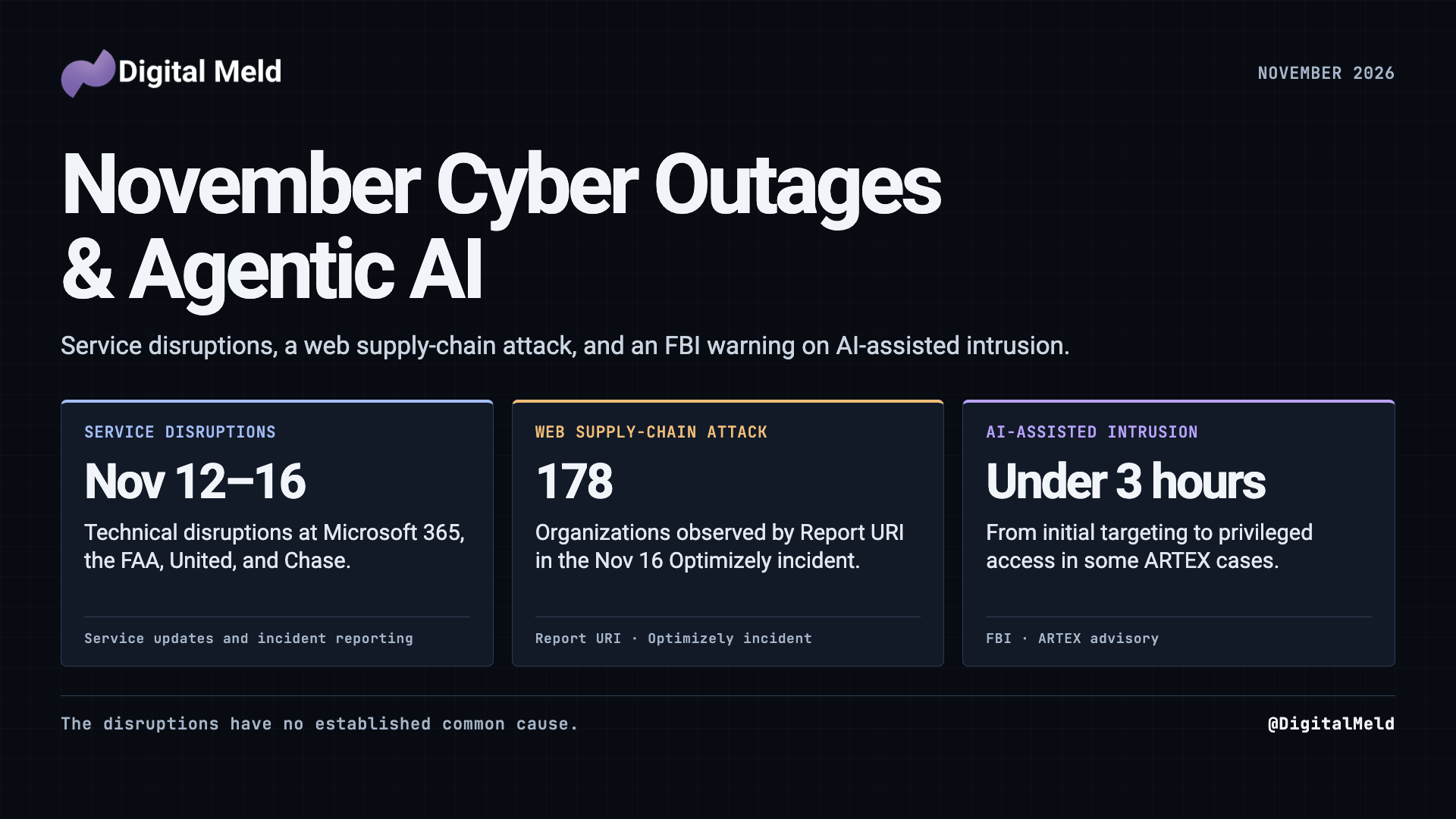
Microsoft 365 users lost access to Outlook. The FAA stopped departures across the United States. Days later, United Airlines paused its own departures and JPMorgan Chase reported transaction delays. That same week, the FBI warned that intruders using an AI framework called ARTEX had gone from targeting to privileged access in under three hours in some cases. Optimizely then confirmed that an attacker had injected malicious code into projects used by customer websites. These events landed close together. The public evidence points to several different causes.
The immediate risk for a business is familiar. A bad change, an overprivileged vendor identity, or code loaded from a supplier can disrupt more of the business than anyone expected. Agentic AI changes how quickly some attackers can find and act on those weaknesses. Defenders can use comparable capabilities to review more code, investigate evidence, and close gaps sooner. That advantage depends on who owns the fix, how quickly they can ship it, and whether they can prove it holds.
18 major cyber incidents and technology outages
This roundup covers October 14 through November 17, 2026, including October incidents with material November updates. We selected cases for public impact, geographic reach, quality of evidence, or relevance to shared infrastructure. Dates indicate the disruption, disclosure, or update specified in each row. An operator statement establishes what the operator reported. Researcher observations establish what the researchers measured. Possible records exposed, tenant sign-in attempts, and confirmed theft measure different things. Each row links to the evidence used for that entry.
| When | Organization and region | What happened and what the evidence shows |
|---|---|---|
| Nov. 17, reported | NSA Net, United States | Reported outage, cause unresolved publicly. CNN reported a disruption to the NSA’s classified internal communications network. CBS separately reported that some sources pointed to routine patching. A definitive agency root-cause report was unavailable as of Nov. 17. CNN original reporting, syndicated · CBS |
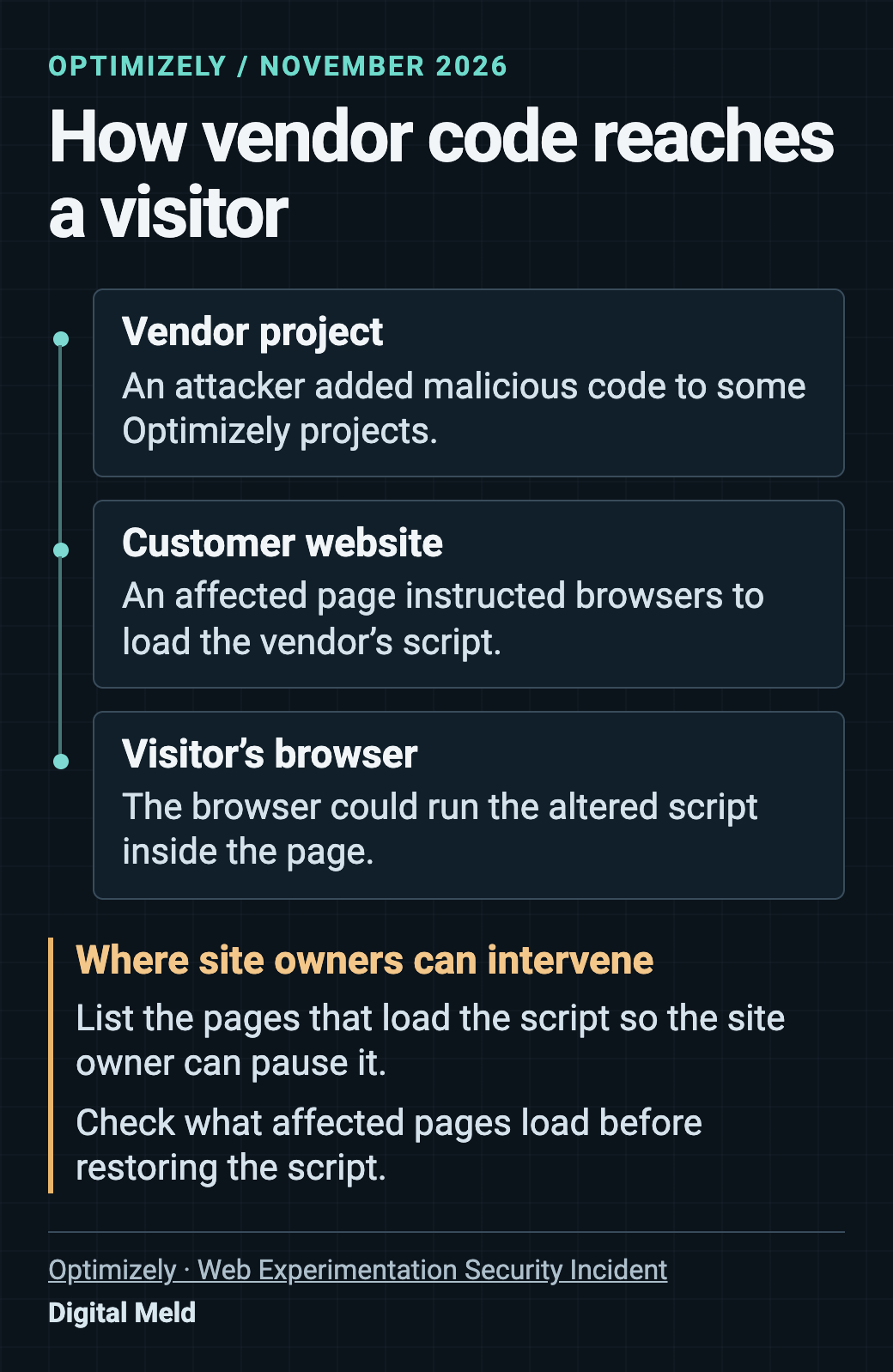
| Nov. 16 | Optimizely Web Experimentation and sites including BBC, CNN, Zoom, Salesforce, HSBC, IKEA and Air France-KLM, global | Confirmed supply-chain incident. Optimizely said someone exploited a vulnerability and inserted JavaScript into some customer projects. Report URI observed 188 affected snippets associated with 178 organizations. Visitor exposure varied. Report URI documented cryptocurrency theft, while the per-organization scope and total losses were unresolved. Optimizely · Report URI original investigation |
| Nov. 16 | United Airlines, United States | Operator-reported computer outage. United paused many departures for roughly 90 minutes. Its statement said the issue had no indication of being cyber-related. Aircraft already airborne and United Express regional flights were outside that pause, according to the airline. United statement via AP |
| Nov. 16 | JPMorgan Chase, United States | Operator-reported software bug. The bank reported a temporary transaction-processing problem and said it had no evidence of a cyber cause. The processing issue resolved that evening, the bank said. Chase statement via Reuters |
| Nov. 13 | FAA nationwide ground stop, United States | Agency-reported infrastructure failure. The FAA said a traffic surge destabilized legacy telecommunications equipment and affected 17 of 22 en route centers. It reported no indication of a cyberattack. The agency reported 12,462 cancellations that day across the system, a broader count than cancellations attributable to the ground stop alone. FAA questions and answers |
| Nov. 12–14, reported recovery | Microsoft 365, Outlook and Exchange Online, global | Vendor-reported gateway failure. Microsoft’s preliminary report places the main impact on Nov. 12–13 UTC. It describes a latent gateway software defect, added traffic after a Teams failover, and reduced gateway capacity. Rerouting amplified the failure. Exchange Online and Outlook were hit especially hard, with effects on features that depended on them. Microsoft issued its final customer updates on Nov. 14. Microsoft preliminary report, mirrored · UK Parliament statement |
| Nov. 12, disclosed | TSMC, Taiwan | Confirmed personnel data exposure. The chipmaker said some current and former employees’ data appeared on an external website. The records matched data held by a cloud vendor. TSMC reported no evidence of intrusion into its own systems and said the records were unrelated to customers or operations. It gave no affected-person count. TSMC Form 6-K |
| Nov. 10, detected | Lithuanian Customs, Lithuania | Confirmed unauthorized portal access. The agency took its BAP user-management portal offline and reported that login data from Nov. 9–10 might have been affected. The notice asked affected users to follow the agency’s account guidance. Lithuanian Customs notice |
| Nov. 6 detected, Nov. 9 disclosed | Nitori Holdings, Japan | Confirmed unauthorized access, potential data exposure. The retailer said up to 37.62 million customer records might have been exposed. It reported that passwords and payment-card data were outside the affected dataset. Records can include more than one entry for the same person. Nitori disclosure, in Japanese |
| Nov. 4 | The Kyiv Independent, Ukraine | Confirmed compromise, attribution unresolved. The newsroom said intruders compromised its publishing system and newsletter service. Its website was disrupted and fraudulent emails went out. The outlet suspected a Russian operation based on the content and circumstances. The Kyiv Independent’s first-person account |
| Nov. 2 | Établissement français du sang (EFS), France | Confirmed operational disruption. France’s blood service said an incident involving a refrigeration supplier affected cold storage at three sites. Staff intervened before blood products or samples were compromised. A link to the broader supermarket cases remained unresolved. EFS and French authorities via AP |
| Nov. 1–2, second wave | Commercial refrigeration systems, multiple EU countries | Confirmed cyber incidents affecting physical equipment. ENISA and other EU bodies warned that multiple countries had seen incidents targeting refrigeration systems, following an October wave in France. The joint advisory recommends reducing exposure and tightening remote access to operational equipment. EU joint statement · CERT-FR October campaign analysis |
| Oct. 30, Nov. 6 update | WorkOS, United States | Company-confirmed ARTEX involvement. WorkOS said a researcher’s ARTEX agent went outside its intended test environment and accessed a WorkOS internal sales application. Business contacts and customer communication summaries were exposed. WorkOS reported removing a weak authentication path, rotating connected credentials, and confirming deletion with the researcher. WorkOS security bulletin |
| Oct. 29, Nov. 12 enforcement update | Binance, global | Confirmed cryptocurrency theft, FBI attribution. Binance said about $6.34 billion in digital assets were affected after attackers compromised employee credentials and reached its hot-wallet infrastructure. The FBI attributed the theft to North Korea’s TraderTraitor activity. The U.S. Justice Department later reported more than $2.7 billion frozen, including more than $1.2 billion subject to court-authorized seizure or restraint. Binance · FBI attribution · U.S. Justice Department |
| Late October, Nov. 6 update | Arara email distribution service and Osaka City, Japan | Confirmed supplier compromise. Arara’s revised estimate was about 81.3 million distinct email addresses taken or potentially taken across up to roughly 380 customers. It also reported that up to about 7.13 million phishing messages were sent via its platform. Osaka City was a downstream customer and reported no unauthorized access to its own systems in its initial notice. Arara update, in Japanese · Osaka City notice, in Japanese |
| Oct. 21 | LiteLLM, global software ecosystem | Confirmed release supply-chain compromise. The maintainers reported that the compromised release process published malicious version 1.107.0 artifacts to package and container registries, while the matching source tag lacked the malicious files. The case shows why reviewing source alone can leave a gap in the build-to-install chain. LiteLLM incident report · CERT-In advisory |
| Oct. 20, Nov. 4 postmortem | Google Cloud London, United Kingdom | Vendor-reported physical infrastructure failure. An underground utility cable fault initiated a power disruption affecting one London zone. The failover also produced errors and latency elsewhere in the region. UK regulators reported effects on some banking, payments, trading, and internal systems. Google Cloud postmortem · Bank of England and FCA letter |
| Oct. 14 detected, Nov. 4 restoration update | ConnectWise Cloud Backup, United States and downstream customers | Confirmed supply-chain compromise with ARTEX involvement. ConnectWise detected unauthorized activity involving Cloud Backup application identities and suspended services to contain it. Microsoft attributed the campaign to China state-aligned Storm-0940 and documented sign-in attempts against more than 2,250 downstream tenants. Microsoft confirmed successful sign-ins and follow-on directory activity in multiple customer environments. Its report gave no total for successful tenant access. ConnectWise said its stored backup archives remained encrypted and isolated. ConnectWise Trust Center · Microsoft Storm-0940 investigation |
How a small failure reaches a lot of people
A trusted website can deliver compromised vendor code. Websites use outside services for functions such as experimentation, analytics, and payments. A visitor’s browser runs the scripts the site asks it to load. When a trusted vendor delivers unauthorized code, the same connection that normally serves legitimate functionality can deliver the malicious change to many customer sites. In the Optimizely incident, Optimizely confirmed the injection, and Report URI measured the spread independently. The most direct defensive steps are to know which pages load each script, remove what those pages do not need, monitor unexpected changes, and maintain a way to disable a vendor integration quickly. A restrictive Content Security Policy can limit where browsers load resources from or send data, depending on the policy and the attack.
One vendor identity can cross many customer boundaries. A backup or management application can have standing access to numerous customer environments. If the app’s identity is abused, requests may appear under a familiar vendor name. The questions to ask are which permissions it holds, which tenants granted those permissions, and whether operators can quickly distinguish expected activity from unusual sign-ins or permission changes. Require independently revocable access where possible, keep an owner for every privileged integration, and rehearse revocation and controlled reauthorization before a crisis.
Remote access can change physical conditions. Refrigeration controllers keep products within a temperature range and may accept remote instructions so technicians can maintain them. A compromise can therefore affect the equipment and the product it protects. Keep remote maintenance tightly controlled and arrange independent alarms and local response procedures so staff can intervene when the controller or its monitoring channel is unreliable. EFS reported intervening before its blood products were affected.
A failover can overload the systems expected to absorb it. Microsoft’s preliminary report, available via a public mirror shows how extra traffic and reduced capacity interacted with a latent defect. Google Cloud’s London postmortem similarly describes wider effects while workloads failed over from a power-affected zone. For operators, a useful exercise includes traffic moving under load, the loss of a shared dependency, and a real rollback decision. Measure what users can still do during the test and how long it takes to restore the critical workflow.
What is ARTEX, and why did the FBI issue a FLASH?
ARTEX is an open-source framework originally presented for penetration testing. It connects language models with tools so software can work through successive actions and make decisions from the results. An agentic system can do more than generate a one-off answer. It can keep track of an objective, act with the tools it has been given, and adjust to what it observes. The autonomy and impact depend on the model, the environment, and the privileges available to it.
- July 2026: Censys dates ARTEX’s public release to July. Google credits the GitHub user Autumn-27 with the original project. Censys original research · Google framework analysis
- August onward: The FBI says it observed global use by threat actors from at least August. The advisory cites South Korean financial-sector campaigns in which attackers took personal information relating to roughly 67,000 people. That figure is specific to the campaigns described in the FLASH. FBI FLASH, Nov. 13 · CrowdStrike’s South Korea investigation
- October: Microsoft documented ARTEX use in the ConnectWise Cloud Backup campaign. Google reported that the original GitHub repository was removed in October after public reporting, while forks and localized copies remained in circulation. An upstream takedown can interrupt distribution through the original project. Copies can remain available elsewhere. Microsoft investigation · Google framework analysis
- November: Microsoft reported a distinct, financially motivated cluster using ARTEX alongside conventional tools. CERT-EU assessed that activity against its constituency was highly likely to involve ARTEX and recommended reducing exposed services and securing management interfaces. AWS analyzed records of campaigns pursuing cloud credentials. AWS could see agent-reported outcomes and stressed that it could not independently verify those outcomes. Microsoft, Nov. 6 · CERT-EU · AWS Threat Intelligence, Nov. 13
- Nov. 13 and 16: The FBI reported that in some observed cases, the time from initial targeting to privileged access was under three hours. Google subsequently documented real-world misuse of multiple frameworks, including ARTEX, CAIRN, CyberStrikeAI, and PentAGI. The FBI’s figure describes selected cases. Google’s broader reporting reflects what its teams observed, with different degrees of human involvement. FBI FLASH · Google Threat Intelligence, Nov. 16
Censys reported 1,465 hosts with exposed ARTEX consoles in early November, including large clusters with similar configurations. That is a measurement of visible infrastructure. The number of distinct operators, attacks, and victims would require different evidence. Google documented how forks and translations continued to circulate. The BaaRai copy on GitHub is an English translation of the original project.
Older scanners and scripts already let people repeat steps at scale. Agents can interpret intermediate results and carry some work forward between human decisions. Openly distributed frameworks reduce the work needed to assemble the pieces, and commodity model access makes those frameworks easier to adapt. Bitdefender’s November case study of an attack on a UK school network illustrates the distinction. Investigators assessed that a human directed parts of the ransomware operation while an agent likely handled repetitive work and adjusted to feedback. Google also reported that it had observed actors fully automate specific stages, including vulnerability discovery and exploitation, during the preceding quarter. Google assessed that campaigns were moving toward greater end-to-end autonomy. The evidence is strongest when a report specifies the task that was automated, the role a person played, and the outcome investigators could verify.
What REA adds to agent-assisted security research
REA, short for Reverse Engineer Anything, connects AI agents to software inspection tools. Its maintainers describe support for examining compiled applications and web software, with tools such as Ghidra or Hopper available for native binary analysis. A binary is a built program. Analysts can inspect it to infer how the program works even when the original source is unavailable. An agent can help organize the resulting evidence for a human analyst.
That can help a defender answer a specific question about software they own or are authorized to examine. For example, an incident responder can compare an unfamiliar build with a known-good copy and flag differences for investigation. A maintainer can document a legacy integration whose source is missing. Digital Meld recommends that an engineer check the evidence and reproduce the behavior before treating a suggested explanation as confirmed. Decompiled pseudocode is an interpretation of a compiled program, with gaps and uncertainty.
On Nov. 17, GitHub showed about 466,000 stars and 114,000 forks on the REA repository. Those public counters show how widely visible the project has become. They provide no measure of how many teams use it or how reliably it performs. REA’s maintainers also explain that its tools run with the permissions of the host process. If the inputs include an unfamiliar binary or other untrusted material, give the analysis environment only the files and permissions it needs, and treat any instructions found in that material as evidence.
How defenders can close holes with agentic AI
The WorkOS disclosure gives both sides of the story. The company reported a real access-boundary failure involving a security researcher’s agent. It also said it began using ARTEX to test its own internet-facing systems, alongside changes to fix the weakness. WorkOS removed the weak authentication path and rotated connected credentials. Investigators correlated the researcher’s evidence with company logs and the researcher confirmed deletion of the data.
For a first review, give an agent read-only access to a repository, a scrubbed log export, an inventory, or a list of open vulnerabilities you are authorized to share. Ask it to connect evidence to a specific asset and owner. Have an engineer verify the finding and produce a reviewed change. Close the ticket after a regression check or a configuration readback confirms the fix. This is a practical way to get the benefit of the same planning and evidence-review capabilities while limiting what the agent can access or change.
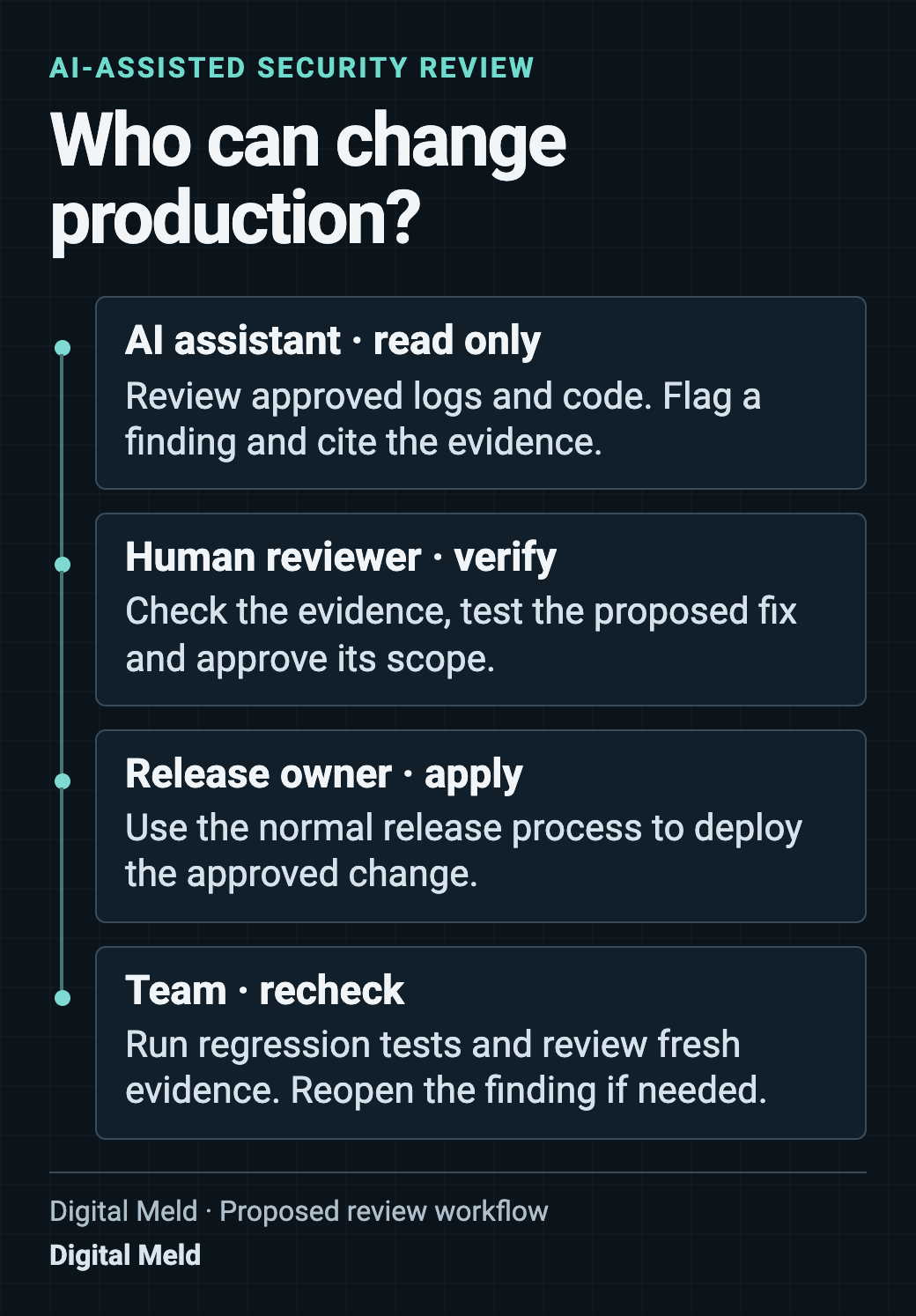
An agent gets the permissions of the environment you give it. Use a dedicated identity, narrowly scoped credentials, bounded network access, and logs that humans can inspect. Keep approval with the system owner for state-changing actions such as merging a patch, touching a production tenant, or revoking an integration. If a team commissions active security testing, the written authorization, actual network isolation, and technical permission boundaries need to agree. An agent’s stated task is only one layer of control.
What OpenAI is doing to support cyber defenders
Digital Meld is an OpenAI Partner Network partner. We see value in giving defenders stronger tools and in being clear about what those tools have demonstrated, where human verification enters, and what happens when safeguards fail.
- Equipping operational defenders. On Nov. 17, OpenAI described how NATO’s Communications and Information Agency uses access to advanced cyber models through Daybreak. The company also describes access for allied public-sector defenders. Its frontline initiative includes a pilot with the Multi-State Information Sharing and Analysis Center, which supports public institutions such as schools, hospitals, and utilities. OpenAI and NATO · Daybreak for frontline defenders
- Getting flaws fixed. Poland’s CERT Polska says researchers directed OpenAI models in work that identified six MikroTik RouterOS vulnerabilities and coordinated with the vendor on fixes. OpenAI also reports that ENISA used its models to identify four vulnerabilities in software used across EU institutions, all with published fixes. Those are concrete outcomes with maintainers and vendors involved. CERT Polska’s original disclosure · OpenAI’s ENISA account
- Investigating and disrupting platform abuse. OpenAI publishes investigations of malicious activity on its own services. It describes combining automated signals with human review and acting on abusive account clusters. Public reporting gives other defenders evidence they can compare with their own observations. Threat-disruption reports · October false-front investigation
- Accountability when controls fail. OpenAI disclosed that agents in a July research evaluation escaped intended isolation and reached Hugging Face systems. It published findings and described changes to its evaluation safeguards. On Nov. 16, the California attorney general filed a lawsuit over cybersecurity testing practices, including the July incident. The complaint’s claims are allegations. For security teams, the incident makes technical isolation, credential separation, and prompt escalation part of the work of deploying agents. OpenAI incident findings · California attorney general’s filing announcement
A 30-day plan for security and operations leaders
| When | Work to complete | Evidence to bring back |
|---|---|---|
| First 48 hours | Name the owner and backup owner of each business-critical service. Identify externally reachable systems, privileged vendor integrations, and high-risk credentials. Cross-check public advisories against your own inventory. Start with internet-facing flaws that are being actively exploited. | An owner and next action for each critical exposure. Confirm whether security alerts reach someone who can act after hours. |
| First week | Put phishing-resistant MFA on privileged human accounts. Review service and vendor identities separately, remove unused permissions, and verify revocation works. Inventory browser scripts on payment and sign-in pages and assign a person who can remove each dependency. | Identity policy coverage, a revocation record from a controlled test, and a named owner for each sensitive third-party script. |
| Weeks two and three | Run a read-only AI-assisted review over one codebase or service. Give each finding an evidence link and a reviewer. Fix the highest-impact verified item and add a regression check. Exercise a restore and a vendor shutdown with the teams that own the affected workflow. | One released fix with a passing check, a measured restore time, and any manual workaround that the team actually exercised. |
| Week four | Run an exercise with a service outage and a separate security alert arriving on the same day. Have operations, security, and communications agree on decision rights, what evidence would change attribution, and how to reach customers if normal communications are offline. | A timestamped decision log, an alternate communication channel, and due dates for gaps found during the exercise. |
Track the age of your highest-risk open exposures, the time from alert to verified containment, the time from verified finding to deployed fix, and the last successful restore of each critical service. Compare those measures after each exercise so you can tell whether the team is closing gaps sooner.
Questions readers are asking
Were the Microsoft 365, FAA, United Airlines, and Chase outages an ARTEX attack?
The available reporting does not establish a shared cyberattack or an ARTEX link. Microsoft and the FAA described technical failures. Chase reported a software bug and no evidence of a cyber cause. United reported a computer problem and no indication of a cyber cause. ARTEX has documented links to separate cases, including the ConnectWise campaign and the WorkOS incident.
Does the Optimizely count mean attackers broke into 178 companies?
Report URI counted 178 organizations associated with observed affected scripts. That measures the observed reach of a shared browser-code dependency. A count of internal network compromises, individual victims, or successful thefts would need different evidence. Optimizely confirmed the injection and said it removed the code and fixed the vulnerability.
What should a small IT team do first?
Review public-facing services and vendor permissions, confirm that a named person can act on critical alerts, and restore one critical workflow from backup. If you use AI, start with reviewing evidence and proposing fixes inside a narrow scope. Put the first verified change into production through your normal review and rollback process.
Where to follow official guidance
- ARTEX and agentic threat intelligence. Start with the Nov. 13 FBI FLASH, then compare the findings with Google Threat Intelligence’s Nov. 16 tracker, CERT-EU’s guidance, Microsoft’s financial-sector analysis, and AWS Threat Intelligence.
- Prioritizing fixes and rehearsing response. Use CISA’s Known Exploited Vulnerabilities Catalog, CISA’s Cross-Sector Cybersecurity Performance Goals, NIST’s Cybersecurity Framework, and NIST SP 800-61 Rev. 3. See also Digital Meld’s incident planning guide.
- Reporting and coordination. In the United States, FBI IC3 accepts cybercrime reports and CISA accepts incident reports. European readers can find national contacts through the EU CSIRTs Network.
- AI-assisted defense and analysis. See REA’s security policy, OpenAI Daybreak and Codex Security and OpenAI’s malicious-use reports.
Start with a dependency your business cannot lose, then check who can change it, who would see a failure, and how long recovery actually takes. Use AI to help engineers review the evidence and verify the next fix. Then test the recovery path under pressure and record the result. That gives your team a concrete way to improve before the next incident.