
Circular deals, physical limits, and why AI regulation needs independent authors.
Abstract
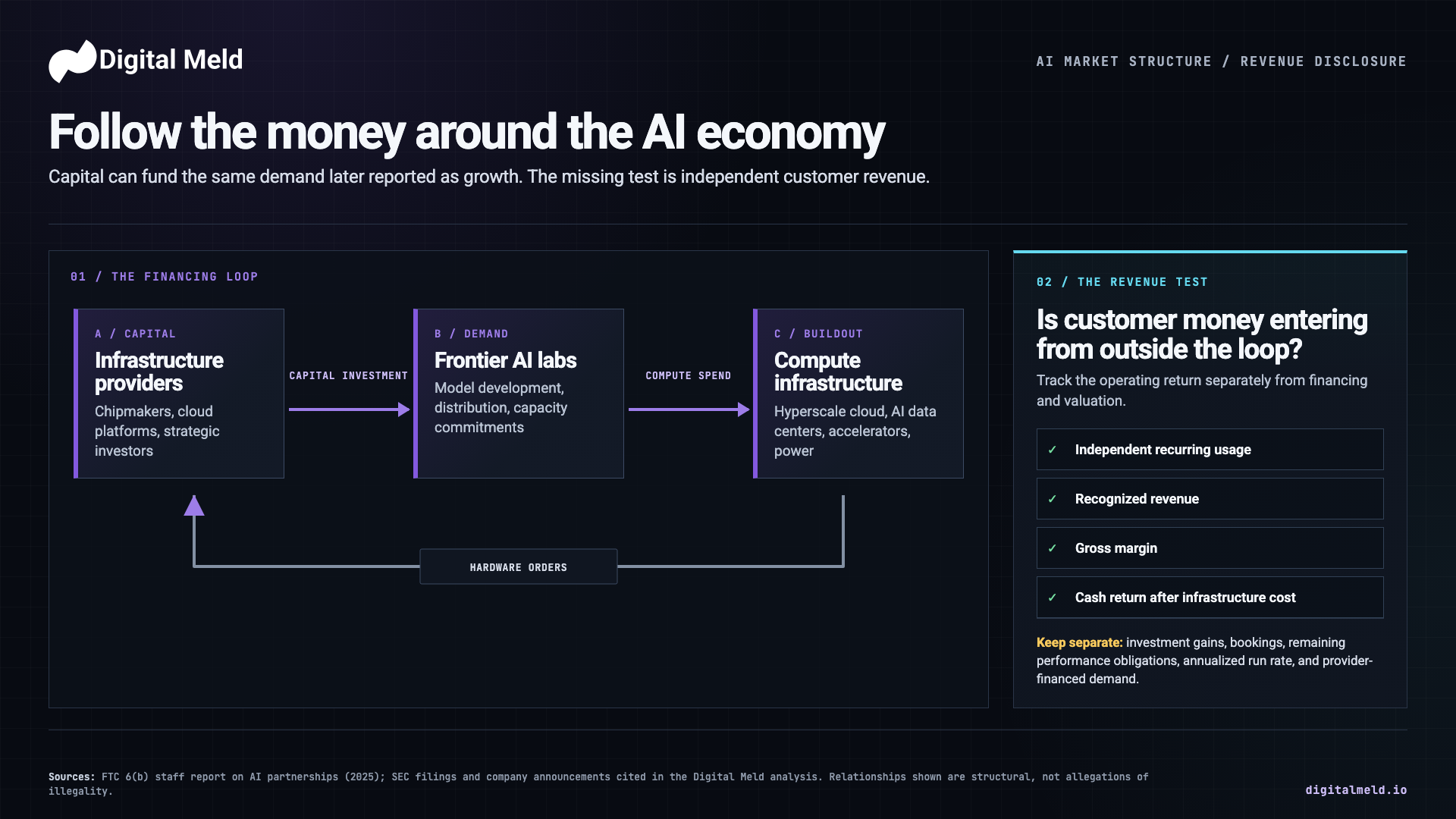
Artificial intelligence already creates measurable value in bounded business workflows. At the same time, the frontier AI economy is being financed through an increasingly dense network of investments, equity warrants, cloud-purchase commitments, capacity reservations, and supplier relationships. Chipmakers invest in model companies that buy their chips. Cloud providers invest in model companies that commit to their cloud. Specialized AI clouds receive investment from the suppliers whose hardware fills their data centers.
These relationships can be rational ways to finance expensive infrastructure. They also recycle demand, concentrate risk, raise switching costs, and make the industry's headline growth harder to interpret. The Federal Trade Commission has already documented several of these dynamics. Provider revenue is growing, but the disclosures rarely let us connect AI revenue, margins, customer concentration, and capital consumed with the precision the investment story demands.
The financial buildout is happening alongside claims that artificial general intelligence, or even artificial superintelligence, is close. Public evidence does not support planning a business around that claim. Definitions remain unsettled, current systems show jagged and unreliable performance, and the physical infrastructure required to deploy advanced AI at economy-wide scale moves on multi-year timelines.
Digital Meld's position is practical. Use AI now where the workflow, evidence, controls, and economics make sense. Regulate it where safety, rights, competition, infrastructure, and public costs require rules. Make those rules through independent evaluation and balanced participation. The companies building and selling frontier systems have useful evidence to contribute, but they cannot be allowed to define the public interest on their own.
Why Write This Now?
The AI market increasingly asks the same companies to act as investor, supplier, customer, landlord, cloud provider, and distribution partner. These arrangements can be rational ways to finance expensive infrastructure. They also complicate a basic accounting question: how much independent customer revenue is entering from outside the financing loop, and what return is all of this capital producing?
At the same time, businesses are being told to prepare for AGI as though it were a normal product milestone. Most organizations still need capital, time, clean enough data, executive support, people who understand the work, and a partner who can connect the technology to the operation. A useful pilot can happen quickly. Durable operating change usually cannot.
That leaves three questions that are too often mashed into one argument:
- Is AI useful today?
- Is the financial structure around frontier AI healthy?
- Does current progress mean AGI or ASI is close?
The answers do not rise and fall together. AI can be useful while parts of the market are overbuilt. Frontier models can improve quickly while remaining far short of reliable general intelligence. Good regulation can protect people and competition while bad regulation builds a moat around the companies that already have the most money and political access.
The evidence supports concern about leverage, concentration, counterparty exposure, and recycled demand, while offering no reliable date for a break. Market-crash dates and AGI dates should face the same scrutiny.
That is the standard for this paper. Follow the documented relationships. Mark forecasts as forecasts. Keep the useful technology separate from the stories being used to finance it.
What Is a Circular AI Deal?
A circular deal moves value around a set of related companies in a way that can return some of the original capital to the party that supplied it.
Imagine a chipmaker investing in an AI lab. The lab uses that capital, directly or indirectly, to buy systems built with the chipmaker's hardware. The chipmaker records hardware demand and gains an equity interest in the customer. The lab gains compute and another headline valuation. If a cloud provider or data-center operator sits between them, the circle has another step, but the economic alignment remains.
That does not make the deal illegal, fraudulent, or even irrational. Large infrastructure projects have always used supplier financing, long-term offtake agreements, joint ventures, prepayments, equity kickers, and capacity reservations. The questions are whether the obligations are transparent, whether demand exists outside the financing loop, whether counterparties can perform without continuous refinancing, and who absorbs the loss if the forecast is wrong.
The Federal Trade Commission's 2025 study gives us a better starting point than any bubble chart. The FTC examined Microsoft/OpenAI, Amazon/Anthropic, and Google/Anthropic. It found equity and revenue-sharing rights, consultation and exclusivity rights, shared technical and financial information, discounted compute, and commitments requiring AI developers to spend a large portion of a cloud partner's investment on that partner's cloud services.
The FTC did not declare the partnerships unlawful. It identified the operating risks: higher switching costs, tighter access to compute and engineering talent, sensitive information flowing to powerful partners, and competitive disadvantages for developers outside the major alliances. Those are exactly the kinds of structural risks clients and policymakers should understand.
Follow the Money Around the Circle
The most useful way to evaluate the market is to read what the companies told investors and regulators. Several current deals are unusually direct.
NVIDIA and OpenAI
In September 2025, NVIDIA and OpenAI announced a letter of intent covering at least 10 gigawatts of NVIDIA systems. NVIDIA said it intended to invest up to $100 billion in OpenAI, progressively, as each gigawatt was deployed.
The words matter. This was an announced intent for “up to” $100 billion. Cash transfers and revenue recognition depend on later deployment. Still, the structure is clear: the hardware supplier invests as the customer deploys more of the supplier's hardware.
AMD and OpenAI
AMD and OpenAI announced a six-gigawatt agreement in October 2025. AMD also issued OpenAI a warrant for up to 160 million AMD shares. Vesting is tied to deployment milestones, AMD share-price targets, and OpenAI's technical and commercial milestones.
This structure goes beyond a normal volume discount. The buyer can gain a material equity position in the supplier as the buyer purchases more of the supplier's systems. That may align incentives, but it also changes the economics of the purchase. The hardware decision, the supplier's share price, the customer's capacity plan, and the customer's potential equity gain are now connected.
Microsoft, NVIDIA, and Anthropic
In November 2025, Microsoft announced that Anthropic had committed to purchase $30 billion of Azure compute capacity and contract for up to one gigawatt. In the same partnership, NVIDIA committed to invest up to $10 billion in Anthropic and Microsoft committed up to $5 billion.
The circularity appears in the public announcement. Anthropic receives investment from the cloud and hardware side of the ecosystem, then makes a large compute commitment to Azure using NVIDIA systems. Microsoft gains a major cloud customer and access to Claude across its products. NVIDIA gains demand for its architecture. Anthropic gains capital, distribution, and compute.
AMD and Anthropic
AMD followed with a similar structure in July 2026. Anthropic agreed to deploy up to two gigawatts of AMD systems beginning in 2027. AMD committed to invest up to $5 billion in Anthropic, and AMD said it would broadly adopt Claude in its engineering and product teams.
Each leg of the agreement can produce legitimate value. The full package also makes independent price discovery harder. Investment, product adoption, engineering collaboration, and hardware demand arrive together.
OpenAI, SoftBank, and SB Energy
One of the cleanest examples came in January 2026. OpenAI and SoftBank each agreed to invest $500 million in SB Energy. OpenAI signed a 1.2-gigawatt data-center lease with SB Energy, and SB Energy agreed to become an OpenAI customer by using its APIs and deploying ChatGPT internally.
Capital, infrastructure rent, and software spending move in several directions. That does not erase the value of the data center or the software. It does mean the parties are creating demand for one another while holding financial interests in the same buildout.
NVIDIA and CoreWeave
NVIDIA invested $2 billion in CoreWeave in January 2026 as the companies expanded a plan for more than five gigawatts of NVIDIA-based AI infrastructure by 2030. NVIDIA's subsequent Schedule 13G/A reported ownership of 11.5% of CoreWeave's Class A shares.
CoreWeave is an important supplier of GPU cloud capacity, and its business is real. Its 2025 Form 10-K also reported $21.6 billion in debt and identified substantial indebtedness, customer concentration, limited supplier choice, and capital requirements as material risks. When a hardware supplier owns part of the cloud provider that buys and operates its hardware, supplier strength and customer risk become intertwined.
The commitments are getting larger
NVIDIA's own filings show how far the exposure extends. As of January 25, 2026, NVIDIA reported $95.2 billion in manufacturing, supply, and capacity commitments, $27 billion in multi-year cloud-service commitments, and $11.4 billion in investment commitments. By April 26, its disclosed investment commitments had grown to $27 billion. Those figures come from NVIDIA's 2026 Form 10-K and April 2026 Form 10-Q.
Oracle shows the financing burden from the cloud side. In its fiscal 2026 results, Oracle reported $638 billion in remaining performance obligations, $43 billion raised through debt, $5 billion raised through equity, and an expectation of roughly $40 billion in additional debt and equity financing during fiscal 2027. Oracle also explained that customers had prepaid for or supplied $75 billion of GPUs tied to large AI contracts, reducing Oracle's capital burden. The filing shows both sides of the story: extraordinary demand commitments and extraordinary financing requirements, with some risk shifted back to customers.
We should not add every press-release number and call the result the size of the bubble. Many values overlap. Some are letters of intent. Some are maximum commitments. Some depend on milestones. Some represent planned capacity over several years. Some are binding obligations, while others remain forecasts.
The better conclusion is narrower and more useful: the same group of firms increasingly acts as investor, supplier, customer, landlord, cloud provider, and distribution partner to one another. Reported demand therefore deserves more scrutiny than a normal arm's-length sale.
Why the Loop Matters
These structures can work while capital is available, deployments stay on schedule, utilization grows, and end customers pay enough for AI services. Problems appear when one of those assumptions fails.
A delayed data center can delay a hardware order. A model company that misses revenue targets may reduce cloud purchases. A cloud provider that overcommitted can renegotiate capacity or lower prices. A specialized AI cloud facing refinancing pressure can sell assets into a weaker market. A chipmaker holding equity in major customers can take an investment loss at the same time hardware demand falls.
The parties are also concentrated. NVIDIA's filings say its revenue comes from a limited number of direct, indirect, and cloud-service purchasers. CoreWeave identifies limited customers and suppliers as risks. The FTC found that the major cloud/lab partnerships can raise switching costs and restrict access to important inputs.
None of this proves a crash. It does mean the system has correlated risk. If the same demand forecast supports the lab valuation, the cloud contract, the data-center debt, and the chip order, one miss can travel around the circle.
That is why our clients should care even if they never buy a GPU. Market concentration affects model pricing, cloud availability, vendor portability, contract terms, and the durability of the products built on top of these providers. A procurement decision that looks like a software subscription may carry infrastructure and counterparty risk several layers down.
AI Revenue Is Growing. The Returns Are Still Blurry.
It is tempting to make the argument simple: providers are spending hundreds of billions on AI and have little revenue to show for it. The current filings do not support that statement.
NVIDIA has real revenue. Microsoft and Amazon now report large AI annualized revenue run rates. Alphabet's cloud business is growing quickly. Meta's advertising business is growing while management credits AI with improving the core product. Pretending those results do not exist would repeat the same mistake we are criticizing: choosing the story first and fitting the numbers to it.
The better criticism is that the industry's accounting vocabulary remains much less precise than its investment vocabulary.
| Provider | What the latest primary source reports | What it still does not tell us |
|---|---|---|
| NVIDIA | Fiscal 2027 first-quarter revenue was $81.6 billion, up 85% year over year. Data Center revenue was $75.2 billion, up 92%. | How much downstream revenue and cash return its customers earn from the infrastructure, and how much supplier-supported demand is embedded in future purchases. |
| Microsoft | Its AI business exceeded a $37 billion annual revenue run rate in the third quarter of fiscal 2026, up 123%. Azure and other cloud-services revenue grew 43% in the fourth quarter. | A separate audited AI segment showing recognized revenue, gross margin, customer concentration, capital allocation, and cash return. |
| Amazon | AWS's AI business exceeded a $25 billion annual revenue run rate and was growing at triple-digit percentages. AWS quarterly sales reached $42.2 billion, up 37%. | The definition and margin of the AI business, the portion supported by connected labs, and the portion of infrastructure spending required to sustain that run rate. |
| Alphabet | Google Cloud revenue reached $24.8 billion in the second quarter of 2026, up 82%, while quarterly capital expenditures reached $44.9 billion. | A separate generative-AI revenue or margin line. The filing attributes Cloud growth primarily to infrastructure and platform services and new TPU-system sales. |
| Meta | Second-quarter revenue reached $60.8 billion, up 28%, while capital expenditures were $31.1 billion. | Revenue directly attributable to AI. The filing says the revenue increase was almost entirely advertising, which can reflect impressions, pricing, ranking, engagement, targeting, and many other changes. |
These figures come from NVIDIA's fiscal 2027 first-quarter results, Microsoft's fiscal 2026 third-quarter release, fiscal 2026 results, and Form 10-K, Amazon's second-quarter 2026 results, Alphabet's second-quarter 2026 Form 10-Q, and Meta's second-quarter results and Form 10-Q.
Amazon provides the clearest illustration of why revenue growth leaves the return question open. Its AI business passed a $25 billion annualized revenue run rate. Across Amazon, trailing-twelve-month purchases of property and equipment reached $169.0 billion, and free cash flow fell to negative $7.6 billion. Amazon said the spending increase primarily reflected AI investment. Those company-wide capital figures cover the rest of Amazon as well, so dividing one by the other would be bad analysis. They still show the scale of investment required while the economics are developing.
The same Amazon release reported $53.4 billion in non-operating pre-tax income tied primarily to its Anthropic investment. That amount strengthened reported earnings without representing operating revenue or cash paid by customers. Investment results, recognized revenue, and operating cash flow belong in separate columns.
Microsoft puts the uncertainty in its own risk factors. Its fiscal 2026 Form 10-K says accelerated AI investments are being made before the related revenue streams are fully developed and that the revenue may not arrive at the expected time or level.
Alphabet and Meta show the attribution problem. Alphabet's Cloud revenue is growing rapidly, but Cloud combines core infrastructure, platform services, Workspace, AI services, and now TPU-system sales. Meta says AI improves its core advertising business, which is plausible and may be economically valuable. Its filings do not isolate the effect from ad impressions, pricing, product changes, foreign exchange, and the rest of the advertising system.
Annualized run rate, bookings, remaining performance obligations, token volume, active users, broad segment growth, and recognized revenue are different measurements. A customer funded by its supplier is also different from an independent customer paying from operating cash flow. The industry moves among these measures too casually.
The same standard should govern our client work. Track each layer separately: model demonstration, recurring usage, recognized revenue, gross margin, and cash return. A useful AI program needs a baseline and a ledger covering task volume, labor avoided, incremental revenue, review time, error cost, infrastructure cost, support cost, and switching cost. If we cannot show where the return came from, we should keep measuring instead of declaring transformation.
Does Rapid Progress Mean AGI Is Close?
We need to define AGI before putting it on a calendar. The industry has not settled that problem.
The OpenAI Charter defines AGI around highly autonomous systems outperforming humans at most economically valuable work. Google DeepMind's Levels of AGI framework separates performance, generality, and autonomy into graded levels. Other researchers use cognitive breadth, learning ability, transfer, embodiment, or economic substitution.
These definitions do not identify one finish line. A model can exceed human performance in mathematics while failing a basic visual task. It can write excellent code in a clean repository while losing track of a messy business process spread across emails, policy exceptions, user history, and an undocumented approval chain. It can produce a strong answer once and fail the same task on the next run.
That unevenness matters. General intelligence requires breadth, adaptation, reliability, and judgment across unfamiliar situations. A collection of benchmark wins does not automatically add up to that capability.
Current evaluations show both remarkable progress and large gaps. On ARC-AGI-3, an interactive benchmark designed around agentic reasoning, humans score 100%. As of July 24, 2026, the highest reported frontier result was Claude Opus 5 at 30.2%. That score may move quickly, just as earlier benchmarks did. Today, however, the gap is real.
METR's task-completion time-horizon research is another useful check. Frontier agents have improved rapidly on software, machine-learning, and cybersecurity tasks. METR also warns readers not to confuse its measure with autonomous work duration or job automation. The tasks are unusually clean, well-specified, and easy to score compared with most real work. Performance gets worse on messier tasks, and measurements above 16 hours are unreliable with the current suite.
Stanford's 2026 AI Index technical-performance review describes the same jagged profile. Frontier models gained rapidly on difficult benchmarks and reached gold-medal performance in competition mathematics. At the same time, AI agents still failed roughly one in three attempts on structured benchmarks. The top model read analog clocks correctly about half the time compared with roughly 90% for humans. Robots succeeded on only 12% of real household tasks.
NIST's Generative AI Profile treats confabulation as a natural result of how generative models produce outputs. Better models and better system design can reduce errors. They do not give a probabilistic model the same guarantees as a deterministic control.
This is why Digital Meld does not tell a client to wait for AGI, prepare for AGI next quarter, or assume an autonomous replacement for a department is about to arrive. No public evaluation demonstrates robust, general, reliable, autonomous performance across most economically valuable work. ASI is an even less useful planning term because there is no agreed operational threshold and no public system near one we can test.
Could a research breakthrough surprise us? Of course. We use “years away” as a planning conclusion grounded in the evidence available today. That evidence does not justify an AGI-dependent business plan inside a normal planning horizon. The honest plan uses demonstrated capability, includes an upgrade path, and survives if frontier progress slows.
Intelligence Does Not Build a Power Plant
Even a major model breakthrough would not remove the physical limits around deployment.
The U.S. Department of Energy reports that data centers used about 176 terawatt-hours of electricity in 2023. Its projection for 2028 is 325 to 580 terawatt-hours, equal to roughly 6.7% to 12% of U.S. electricity use. The range in the DOE report is wide because the buildout itself is uncertain.
The International Energy Agency projects global data-center electricity use to more than double to around 945 terawatt-hours by 2030. It also identifies grid connections and supply chains for transformers, turbines, advanced chips, and other equipment as constraints. More efficient hardware helps, but lower cost and better performance can also increase total use.
New generation does not appear when a purchase order is signed. Lawrence Berkeley National Laboratory found that projects completed in 2023 waited a median of five years from interconnection request to commercial operation. Among the capacity that requested interconnection from 2000 through 2018, only 14% had been built by the end of 2023. The Queued Up study covers more than 95% of installed U.S. generating capacity.
Nuclear power is a useful example because it is often presented as the obvious answer for AI load. Vogtle Units 3 and 4 took 11 years and cost more than $30 billion against an original $14 billion estimate, according to the U.S. Energy Information Administration. Future projects may improve on that record. They will still require engineering, permits, financing, equipment, construction labor, transmission, and community acceptance.
The semiconductor chain is similarly concentrated. TSMC's 2025 annual report shows that most of its large fabrication footprint remains in Taiwan while Arizona and Japan expand. ASML states in its 2025 annual report that it is the world's only manufacturer of extreme-ultraviolet lithography systems. The major DRAM suppliers are Samsung, SK hynix, and Micron.
A model can generate a better memo. Delivery still requires factories, skilled trades, engineers, materials, utilities, public approvals, and time. A leap in model capability could increase demand for every constrained input at once.
Businesses Move at the Speed of Operations
The frontier-lab timeline and the client timeline run on different clocks.
The U.S. Census Bureau found that 18% of firms used AI in a business function during its November 2025 to January 2026 reference period. Among the firms using AI, 57% had integrated it into three or fewer business functions. The Census research also found much higher adoption among large firms and knowledge-intensive sectors.
That sounds like the organizations we work with. A useful pilot can happen in weeks. A reliable operating change takes longer because the team has to clean up permissions, connect systems, define exceptions, train users, measure quality, establish support, negotiate security and legal review, and decide who owns the result.
The biggest constraint is rarely access to one more model. It is the work around the model.
An accounts-payable assistant needs approved invoice sources, purchase orders, receipts, vendor records, accounting rules, exception thresholds, segregation of duties, and a person authorized to release payment. A project assistant needs a current schedule, clear status definitions, delivery evidence, and an owner who can resolve conflicts. A customer-service assistant needs access boundaries, escalation rules, identity checks, quality review, and a way to correct the source of truth.
AI is valuable inside these systems. It can read messy records, assemble context, classify an exception, draft a response, and reduce the time a person spends getting oriented. Deterministic controls should still handle totals, limits, permissions, required fields, and other facts that can be proven in code.
This is why we are pro-AI without selling an AGI story. Useful AI is already here. The work is turning capability into a controlled workflow that people can trust, support, and improve.
Regulation Is Necessary, and Capture Is the Risk
Regulatory capture is a real risk, and governing an industry this consequential through provider terms of service and private standards carries its own risk. Good policy has to address both.
AI affects employment, privacy, discrimination, security, intellectual property, public information, critical infrastructure, and competition. Data centers affect grids, water, air quality, land use, tax policy, and ratepayers. Leaving every decision to a provider's terms of service would be a failure of public responsibility.
The better question is who writes the rules, who supplies the evidence, who tests compliance, and who has standing to challenge a bad outcome.
NIST's AI Risk Management Framework offers a practical model. It calls for continuous governance, documented human oversight, testing under deployment-like conditions, independent assessors, and feedback from users and affected communities. That is useful regulation-ready operating discipline even where the framework remains voluntary.
The EU AI Act provides one structural safeguard worth copying. Its advisory forum must balance industry, startups, small and medium-sized businesses, civil society, and academia, along with commercial and noncommercial interests. It also establishes a scientific panel of independent experts.
The FTC's partnership report shows why competition belongs in the safety conversation. A rule that only the largest labs can afford may reduce one category of risk while locking smaller firms and open-source projects out of the market. A disclosure rule written around today's biggest providers may ignore the contractual structures that give those providers leverage over compute, distribution, and data.
Frontier labs belong in the rulemaking process because they understand their systems and have evidence regulators need. Independent researchers, customers, workers, smaller developers, open-source communities, civil society, utilities, local communities, and competition authorities also need meaningful power. A rulebook written around one industry's business model will protect that business model first.
What Good AI Regulation Should Do
For Digital Meld and our clients, good regulation should create clearer operating expectations without freezing the market around today's winners.
Scale obligations to the risk
A model drafting internal meeting notes should not face the same controls as a system denying credit, making employment decisions, directing medical care, operating critical infrastructure, or acting with broad tool permissions. Regulation should focus on the use, capability, autonomy, affected population, reversibility, and potential harm.
Require evidence that matches the deployment
Benchmark scores provide one signal. Providers and deployers should also test the actual system, with its prompts, tools, data, permissions, users, and failure modes. High-risk systems need independent evaluation and post-deployment monitoring alongside a provider's model card.
Make material relationships visible
Customers and regulators should be able to understand major equity interests, cloud-spend commitments, capacity guarantees, exclusivity rights, and other relationships that can affect model availability, pricing, or claimed demand. “Up to” commitments and nonbinding plans should be labeled clearly.
Preserve competition and portability
Rules should not make compliance affordable only for hyperscalers. Common documentation, testing interfaces, incident formats, and data-portability expectations can lower the cost for smaller providers and customers. Open models should be evaluated according to actual capability and use, with obligations placed where control and deployment decisions occur.
Keep people accountable
Every deployed system needs a named owner, an escalation path, an appeal or correction process where people are affected, and authority to suspend or retire the system. “The model did it” cannot become an accountability loophole.
Protect communities absorbing the infrastructure
Ratepayers should not subsidize private AI load without transparent public benefit. Water, emissions, land, noise, resilience, and grid-upgrade costs need enforceable review. Voluntary pledges can support good practice, but public protections should not depend entirely on the continued preference of the companies creating the demand.
Revisit the rules as evidence changes
AI capability and market structure move quickly. Regulations need review dates, public reporting, and a way to tighten or remove requirements when evidence changes. Permanent rules built around a single benchmark or model architecture will age badly.
What This Means for Digital Meld Clients
Our advice remains practical.
Start with a workflow that matters. Name the source of truth. Measure the current cost, delay, error rate, and support burden. Decide which decisions belong to people, which checks belong to deterministic software, and which tasks can use a probabilistic model.
Before deployment, require answers to these questions:
- What exact work will the system perform?
- Which data and tools can it access?
- What evidence must it preserve?
- Which actions require human approval?
- How will we measure accuracy, time saved, and error cost?
- What happens when the provider, model, price, or policy changes?
- Can we export our data, prompts, evaluations, and operating knowledge?
- Who can stop the system?
Do not buy a product because its roadmap says AGI. Buy or build against behavior you can test. Keep vendor options open. Price the review work. Include security, privacy, support, training, and change management in the budget.
This approach may sound slower than a keynote promise. In practice, it ships more value because it gives the organization something real to operate. It also leaves room to adopt better models as they arrive without rebuilding the business around every forecast.
Where We Land
Digital Meld is optimistic about AI because we use it and see where it helps. We are also responsible for telling clients where it fails, what it costs, what it depends on, and what still requires human judgment.
The circular deals around frontier AI deserve scrutiny. The relationships are documented. Their existence does not prove a crash, but their scale and overlap make headline demand less informative and downside more correlated. Investors, customers, and regulators should distinguish capital committed from capital spent, planned capacity from operating capacity, annualized run rate from recognized revenue, and provider-financed demand from independent customer revenue.
AGI and ASI should not be used as shortcuts around that scrutiny. Current systems are improving quickly. They remain jagged, probabilistic, and unreliable across long, messy, high-context work. The grids, fabs, data centers, supply chains, skills, and organizational changes needed for broad deployment take years even when the model is ready.
Regulation belongs in this picture. It should protect people, competition, and communities while keeping the market open to smaller providers and open research. The companies selling frontier systems should bring their evidence to the table. The public process needs enough independent power to test that evidence, expose conflicts, and write rules for everyone living with the outcome.
Use AI now. Measure it honestly. Build the controls. Keep the exit path. Make extraordinary claims earn their way into the plan. Start small, think big.
Methods and Limitations
The analysis does not attempt to value any public company, predict a security's price, prove fraud, establish antitrust liability, or forecast a market failure date. Announced investments and infrastructure values frequently overlap and use contingent “up to” language. Benchmark scores are snapshots and should be refreshed immediately before publication.
References
Financing, competition, and infrastructure agreements
- Federal Trade Commission. Partnerships Between Cloud Service Providers and AI Developers. January 2025.
- NVIDIA. OpenAI and NVIDIA Announce Strategic Partnership to Deploy 10 Gigawatts of NVIDIA Systems. September 22, 2025.
- AMD. AMD and OpenAI Announce Partnership to Deploy 6 Gigawatts of AMD GPUs. October 6, 2025.
- Microsoft. Microsoft, NVIDIA and Anthropic Announce Strategic Partnerships. November 18, 2025.
- AMD. AMD and Anthropic Announce Strategic Partnership. July 22, 2026.
- OpenAI. OpenAI and SoftBank Group Partner With SB Energy. January 9, 2026.
- U.S. Securities and Exchange Commission. CoreWeave Form 8-K for NVIDIA investment. January 26, 2026.
- U.S. Securities and Exchange Commission. NVIDIA Schedule 13G/A for CoreWeave. January 26, 2026.
- U.S. Securities and Exchange Commission. NVIDIA fiscal 2026 Form 10-K. February 2026.
- U.S. Securities and Exchange Commission. NVIDIA April 2026 Form 10-Q. May 2026.
- U.S. Securities and Exchange Commission. CoreWeave 2025 Form 10-K. February 2026.
- Oracle. Fiscal 2026 Financial Results and Capital Funding Plan. June 2026.
Revenue and capital spending
- NVIDIA. Financial Results for First Quarter Fiscal 2027. May 20, 2026.
- Microsoft. Fiscal Year 2026 Third Quarter Results. April 29, 2026.
- Microsoft. Fiscal Year 2026 Results. July 29, 2026.
- Microsoft. Fiscal Year 2026 Form 10-K. July 29, 2026.
- Amazon. Second Quarter 2026 Results. July 30, 2026.
- Alphabet. Second Quarter 2026 Form 10-Q. July 23, 2026.
- Meta. Second Quarter 2026 Results. July 29, 2026.
- Meta. Second Quarter 2026 Form 10-Q. July 30, 2026.
Capability and evaluation
- OpenAI. OpenAI Charter.
- Google DeepMind. Levels of AGI for Operationalizing Progress on the Path to AGI. 2024.
- METR. Task-Completion Time Horizons of Frontier AI Models. Updated May 8, 2026.
- ARC Prize. Announcing ARC-AGI-3. 2026.
- ARC Prize. Claude Opus 5 ARC-AGI Results. July 24, 2026.
- Stanford Institute for Human-Centered AI. 2026 AI Index: Technical Performance. 2026.
- National Institute of Standards and Technology. Artificial Intelligence Risk Management Framework: Generative Artificial Intelligence Profile. 2024, updated 2026.
Energy, supply chain, and adoption
- U.S. Department of Energy. 2024 Report on U.S. Data Center Energy Use. December 20, 2024.
- International Energy Agency. Energy and AI. April 10, 2025.
- Lawrence Berkeley National Laboratory. Queued Up: 2024 Edition. 2024.
- U.S. Energy Information Administration. Plant Vogtle Unit 4 Begins Commercial Operation. May 1, 2024.
- TSMC. 2025 Annual Report. 2026.
- ASML. 2025 Annual Report. 2026.
- U.S. Census Bureau. The Microstructure of AI Diffusion. April 2026.
Governance
- National Institute of Standards and Technology. AI Risk Management Framework Core.
- European Union. Regulation (EU) 2024/1689, Artificial Intelligence Act.
- OECD. OECD AI Principles. Updated May 2024.