
Executive and technical buyer guide
The deadline is not the architecture.
Turn transaction authority, system dependencies, Day-1 continuity, separation or integration, transition services, cutover evidence, and steady-state ownership into one executable technology record.
Transition decision framework
Accept six different operating states, not one project finish line.
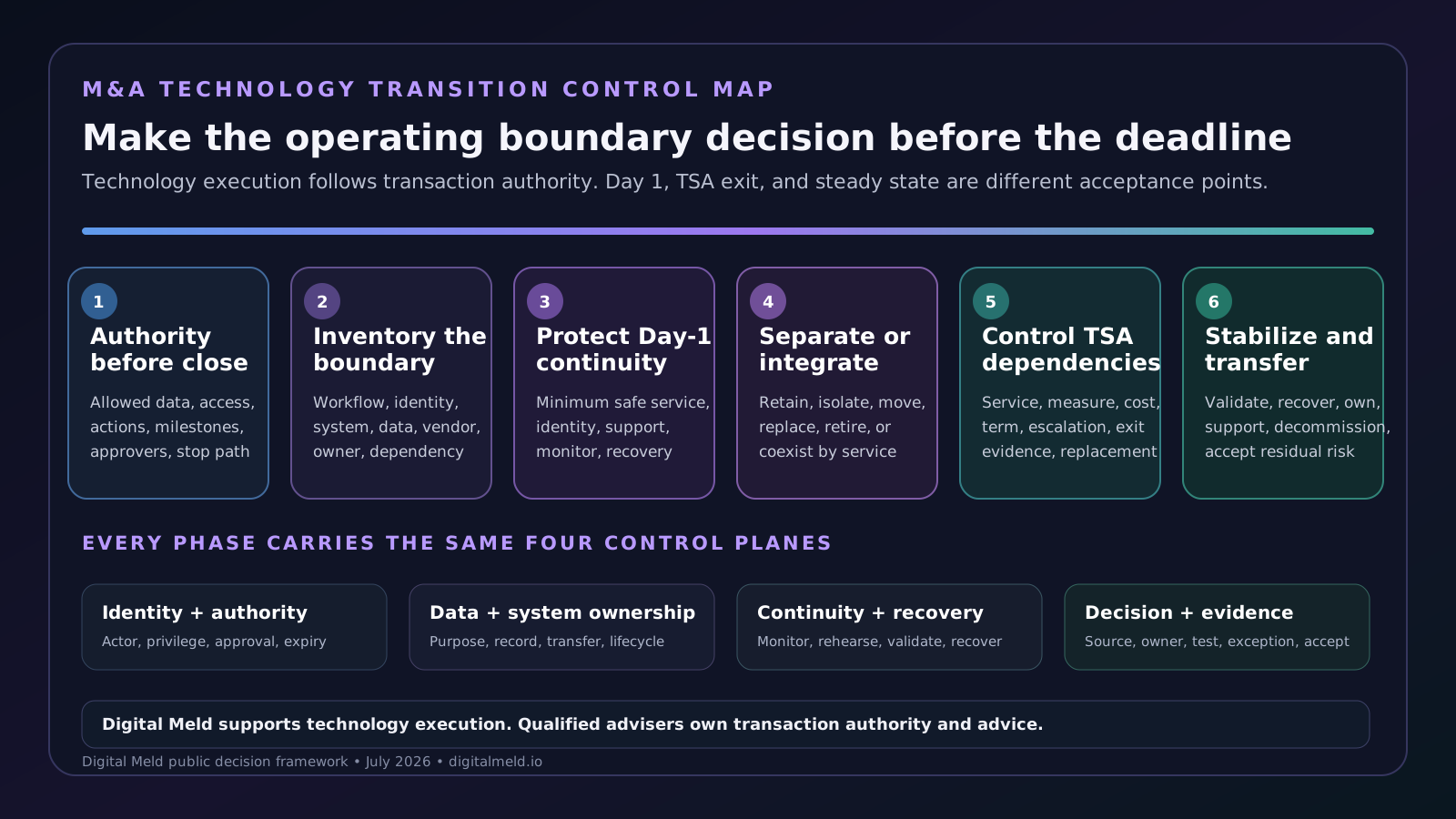
Pre-close authority, Day 1, separation or integration, TSA exit, and steady-state ownership have different decisions and evidence. Treating them as one cutover hides the risk that matters most at each point.
01
Authority before close
Decision
Separate technical preparation from operational action. Record what each team may inspect, share, configure, test, or change before close and who can authorize an exception.
Operating deliverable
A counsel-approved authority and information-sharing matrix tied to transaction milestones, teams, environments, systems, and accountable approvers.
Acceptance evidence
Current legal instruction, access approvals, data-room scope, named administrators, decision log, and a stop path for unclear authority.
02
Inventory the operating boundary
Decision
Map the workflows, identities, devices, networks, cloud, applications, data, interfaces, reports, vendors, licenses, people, and support paths the transaction actually depends on.
Operating deliverable
A bounded inventory and dependency graph with owner, disposition, deadline, evidence state, constraint, cost owner, and fallback for every material service.
Acceptance evidence
Source records, interviews, discovery output, contracts, architecture, integrations, privilege inventory, unresolved assumptions, and sponsor acceptance.
03
Protect Day-1 continuity
Decision
Define the minimum safe operating state at close without pretending every system can or should be migrated by Day 1.
Operating deliverable
A Day-1 service catalog covering workforce access, communications, critical workflows, customer/vendor touchpoints, security operations, support, and executive escalation.
Acceptance evidence
Named users and services, identity and device tests, emergency access, monitoring, support coverage, communication rehearsal, acceptance, and recovery route.
04
Separate or integrate deliberately
Decision
Choose the target boundary for each service: retain, isolate, replicate, migrate, replace, retire, or integrate. Avoid one program assumption across incompatible systems.
Operating deliverable
A target-state and wave decision for every dependency, including data ownership, interface coexistence, control transfer, cost, business interruption, and residual risk.
Acceptance evidence
Architecture decision, source and target owner, data/interface contract, security and privacy review, test plan, wave entry criteria, and approved exception.
05
Transition-services constraints
Decision
Translate every technology dependency on a seller, buyer, shared team, vendor, tenant, or contract into a service, owner, measure, cost, term, exit condition, and escalation path.
Operating deliverable
An operational TSA/service register mapped to the system inventory and exit backlog. Legal counsel owns agreement language; technology owners prove service readiness and exit.
Acceptance evidence
Approved service schedule, service owner, volume/capacity assumptions, access path, measure, issue history, change rule, exit dependency, forecast, and dispute/escalation record.
06
Exit, stabilize, and transfer ownership
Decision
Treat cutover as the start of verified operation. Close a transition only after validation, rollback or recovery, exception ownership, support, monitoring, vendors, and residual services are accepted.
Operating deliverable
A rehearsed cutover and stabilization record plus a named steady-state owner, runbook, service inventory, risk register, backlog, support boundary, and retirement plan.
Acceptance evidence
Rehearsal, go/no-go approval, validation, recovery result, incident and exception record, acceptance, decommission proof, knowledge transfer, and exit sign-off.
Control map
Carry the same four control planes through every phase.
Identity and authority, data and system ownership, continuity and recovery, and the decision record must survive the change from diligence to close to transition to operations.
Risk and control model
Make the boundary inspectable across workstreams.
A decision is not ready because it appears in a workstream deck. It is ready when the source, authority, owner, dependency, evidence, exception, recovery, and acceptance state are explicit.
Legal action and information authority
Counsel and the transaction team define pre-close information sharing, clean-team or other access restrictions, regulatory milestones, and who can authorize operational action. The technology plan records and enforces those decisions.
Identity, privilege, and revocation
Inventory workforce, guest, service, emergency, vendor, application, device, and machine identities. Define issuer, resource, privilege, approval, logging, expiry, transfer, and revocation for each transition state.
Data and privacy boundary
Map personal, client, employee, financial, regulated, confidential, and derived data to purpose, system of record, location, authorized parties, transfer method, retention, deletion, and privacy/legal review.
System and interface ownership
Give every application, integration, domain, certificate, key, queue, report, file exchange, automation, and manual handoff a source owner, target owner, coexistence rule, and failure path.
Cybersecurity and operational continuity
Carry governance, asset knowledge, protective controls, detection, response, and recovery across the old and new boundaries. A migration result is not security or resilience proof by itself.
Vendor, contract, and license dependency
Record assignability, consent owner, tenant or account owner, renewal, usage, capacity, data export, support, termination, transition assistance, and replacement lead time for material third parties.
Cutover and recovery authority
Set wave entry, rehearsal, change freeze, go/no-go, validation, rollback or compensation, emergency change, communication, exception, and stabilization criteria before the cutover window.
TSA service and exit evidence
Connect each transitional service to the systems and people it enables, its measure and escalation path, the buyer capability that replaces it, and the proof required to stop paying for it safely.
Decision and audit record
Keep a dated record of sources, assumptions, decisions, approvers, changes, tests, failures, exceptions, acceptance, and unresolved risk without putting restricted transaction data in the wrong repository.
Steady-state operating owner
Name the post-transition service owner, support window, monitoring, vendors, access review, release and change process, capacity, cost, risk backlog, data lifecycle, and retirement authority.
Technology execution does not authorize the transaction.
Digital Meld maps and executes technology work inside the approved boundary. This page is not legal, tax, financial, regulatory, privacy, or transaction advice. Qualified advisers and accountable client owners decide filings, waiting periods, information sharing, employee matters, data rights, contractual duties, transaction terms, and permitted pre-close action.
Approved transition proof
Enterprise divestiture and Microsoft cloud migration.
The public case connects infrastructure separation, a greenfield Azure control plane, Microsoft 365 and application/data moves, rollback planning, TSA exit, and steady-state support in one founder-experience record.
Separating infrastructure and Microsoft cloud during an enterprise divestiture
A technology carve-out sequenced across identity, infrastructure, Microsoft 365, Azure, applications, data, TSA exit, and steady-state ownership.
Publication note: Anonymized founder delivery experience from before Digital Meld. The client is not named, confidential operating details are excluded, and no client endorsement is implied.
Inspect the case and evidence limitsCarve-out operating sequence
An anonymized four-phase view of the work from separation boundary through destination controls, migration waves, and operating handoff.
View public sourceCurrent authoritative sources
Verify the live authority and product boundary.
These sources support the limited regulatory, security, privacy, identity, and migration statements on this page. They do not decide a specific transaction, and volatile details must be rechecked before action.
FTC: Premerger Notification and the Merger Review Process
Certain transactions require premerger notification and a waiting period. Filing, timing, information-sharing, and pre-close action decisions belong to qualified counsel for the specific transaction.
FTC: HSR Notification Forms, Instructions and Guidance
The current FTC notice shows that forms, instructions, submission methods, and court status can change. Recheck the live source and counsel rather than carrying a filing requirement into a technology plan.
NIST Cybersecurity Framework 2.0
A voluntary risk-management framework organized around Govern, Identify, Protect, Detect, Respond, and Recover. Use a transaction profile to expose control ownership and gaps, not to imply certification.
NIST Privacy Framework
A voluntary enterprise-risk tool for identifying and managing privacy risk. Applicable law, contractual duty, data-subject rights, purpose, transfer, retention, and deletion still require qualified review.
NIST SP 800-207: Zero Trust Architecture
Trust should not be implied by network location or ownership. Authenticate and authorize subject and device for the resource, including temporary and cross-organization access.
CISA Cross-Sector Cybersecurity Performance Goals
Voluntary, prioritized baseline practices that can help a transition team identify high-impact security work. Sector, company, and transaction requirements can demand more.
Microsoft 365 migration overview
Current Microsoft guidance recognizes tenant-to-tenant migration for mergers, acquisitions, divestitures, and reorganizations and separates coordinated from workload-specific paths.
Microsoft Entra cross-tenant access settings
Current inbound, outbound, organization-specific, MFA/device-trust, application, user/group, and cross-tenant synchronization controls. Changing defaults can break business-critical access, so inventory and test first.
Microsoft Cloud Adoption Framework migration planning
Current guidance for workload sequencing, dependencies, data transfer, success criteria, approvals, rollback authority, and review checkpoints. Tailor it to the transaction and workload.
Related transition work
Keep the transaction sequence connected to execution and proof.
The buyer-facing workflow for inventory, Day-1 access, migration, TSA exit, and stabilization services.
The adjacent Microsoft decision framework for configuration, Power Platform, integration, custom software, cloud migration, and operating ownership.
Why escalation, evidence, decision authority, and recovery paths must exist before the transition creates an incident.
A practical operating-ownership lens for capability transfer, adoption, and iteration after implementation.
Next transition decision
Bring the deadline, boundary, dependency, and owner.
We will identify which decisions must be made now, which actions are authorized, what Day 1 must preserve, where transition services carry the dependency, how separation or integration should be sequenced, and what evidence is required for exit.
- Use Transform for the risk, migration, recovery, stabilization, and capability-transfer sequence.
- Use an enterprise SOW when multiple workstreams, environments, vendors, or deadlines require one controlled program boundary.